

Wiki is in the process of importing stuff
Please be patient
This article is about a fictional ideology and has no foundation in real life political movements.
Esoteric Socialism is an File:Authleft.png authoritarian-left, File:Internat.png Internationalist ideology that claims to secretly control the world through groups of powerful cryptocrats.
Variants
[edit]File:Bokki.png Bokkism
[edit]File:Bokki.png Gleb Bokki (1879-1937) was a socialist activist in the Soviet Union. He began his career as a revolutionary, working as a propagandist for the File:ClassSocDem.png Russian Social Democratic Party. Later, he became a strong supporter of the File:Orthlen.png Bolshevik faction within the RSDLP. In his time with the Bolsheviks, he began to showcase a great knowledge regarding the field of cryptography.
After the Russian Revolution, he became a supporter of the File:Vpered.png left communist faction headed by Nikolai Bukharin. This faction sought a revolutionary war against the German occupation, rather than simply giving up territory. Later, during the red terror, perhaps out of fear of retribution from the White Army, Bokki emerged as a File:Moder.png Moderate voice.
This moderation wasn’t just a one time thing. Later, during the suppression of the Kronstadt uprising, he became extremely ideologically disillusioned. As a consequence, he became increasingly interested in mysticism and tantrism.
Inspired by File:Theosophy-icon.png theosophy and several visiting Mongol lamas, Bokki, along with a writer friend of his, embarked on a quest for Shambala. This is a mythological place (somewhere in Northern India) where the birth of the next incarnation of Vishnu, Kalki is said to happen. This birth will usher in a new age, termed the Satya Yuga, which is said to last for 1,728,000 years. He embarked on this search to explore how to combine ideas of Kalachakra-tantra and  communism. Bokki also explored File:Bud.png buddhist techniques in a bid to try and engineer perfect communist human beings.
File:MarxEuras.png Gumilyovism
[edit]File:MarxEuras.png Lev Nikolayevich Gumilev (1 October [O.S. 18 September] 1912 – 15 June 1992) was a Soviet and Russian historian, ethnologist, anthropologist and translator. He had a reputation for his highly unorthodox theories of ethnogenesis and historiosophy and was an exponent of File:ClassEuras.png Eurasianism File:Eurasia.png.
Gumilev's core concept revolves around the ethnos, which he likened to an organism. Drawing inspiration from Academician Vernadsky's biosphere concept, Gumilev argued that the ethnos, like a living being, undergoes distinct stages such as childhood, adulthood, and a declining period. Aligning with the idea that humans are an integral part of nature, Gumilev posited that ethnic groups must adhere to the laws of nature. The paramount principle among these laws is passionarity, signifying the vital energy inherent in each ethnos.
Passionarity is intricately tied to geography; ethnic groups evolving in specific climatic and geographical conditions effectively "adapt" to their surroundings, carving out an "ecological niche" and becoming interconnected with the energy of their habitat. Every ethnos possesses a distinctive "behavioral stereotype" passed down through generations, akin to national mentality. These stereotypes function like animal reflexes, ensuring the preservation of the ethnos over time. As an ethnos matures, it develops its own civilization encompassing elements such as religion, customs, and norms.
While Gumilev did not definitively clarify whether civilization is a biological phenomenon, he asserted that individuals of different races could coexist within the same civilization.
Gumilev did not extend this ethnological ecumenism to the medieval Jews, whom he regarded as a parasitic, international urban class that had dominated the Khazars and subjected the early East Slavs to the "Khazar Yoke". Gumilev maintained that the Jewish culture was by nature mercantile and existed outside and in opposition to its environment. According to that view, Jews share a specific way of thinking, and this is associated with the moral norms of Judaism. According to Gumilev, the medieval Jews also did not bear arms themselves but waged wars by proxies or mercenaries.
File:Ingenieros.png Ingenierosism
[edit]File:Ingenieros.png José Ingenieros (1877 – 1925) was an  Italian- Argentine File:Argentina.png doctor, psychiatrist, psychologist, criminologist, pharmacist, philosopher, Freemason, theosophist, writer, and teacher.
Ingenieros was not what is currently called a "sociologist"; rather, he could be described as a critical essayist. His essays on the society of his time helped to open a dialogue on countless moral and ethical aspects of early 20th-century Argentina, a discussion that originated in various political currents of the time, such as  socialism, File:Freemason.png Freemasonry, communism, and
  anarchism, and which led to the inclusion, albeit transformed, of these principles in vast social movements such as File:Argrad.png Radicalism and File:Pron.png Peronism.
Ingenieros was a prominent representative of File:Positivism.png positivist thought in its early years. He was also one of the founders of socialism in Argentina, although he did not participate formally in party activity. In addition to his purely scientific and social interests, he also had an interest from a very young age in the study of File:Occult.png occultism, parapsychology, and File:Theosophy-icon.png theosophy.
Personality
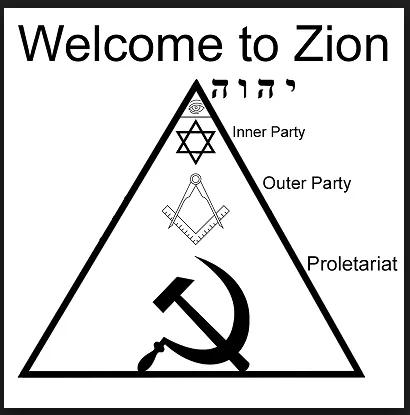
[edit]Esoteric Socialism has 3 somewhat distinct personalities. One personality is secretive, and controls it all in secret alongside his more well-known brother, File:Illum.png Illuminatism. The next one is heavily influenced by theosophy, in a similar vein to File:Esofash.png Esoteric Fascism. The last (but also rare) personality is that represented by a socialist freemason. This personality is essentially a version of popular conspiracy theories connecting communism to the Freemasons and the occult, but entirely unironically.
How to Draw
[edit]- Draw a red circle
- Inside the circle, draw a square and compass with an arm and hammer inside of it in gold
- Draw eyes and you're done
Step 2 violates a rule, but I don't know how to fix it.
Stylistic Notes
[edit]- Esoteric Socialism may be drawn as a ball, triangle, or cube, depending on the artist
- Esoteric socialism might have props such as a Masonic gavel, a tracing board, or a book representing the Volume of Sacred Law. He may or may not have a pet owl.
| Color Name | HEX | RGB | |
|---|---|---|---|
| Red | #D30000 | rgb(211, 0, 0) | |
| Gold | #FCC900 | rgb(252, 201, 0) | |
Relationships
[edit]Friends
[edit]- File:Illum.png Illuminatism - Together, we rule the world. But start to believe that you have no influence without my political power.
- File:Mach.png Machiavellianism - No one can know my true face. I could be a freemason, or I could be a theosophist, or I could be secretly controlling a government's actions.
- File:Antot.png Anarcho-Totalitarianism - I control everything, yet I refuse to govern in an official sense.
 Marxism–Leninism - Based, but you have to embrace mysticism.
- File:Juche.png Juche - My puppet state who is helping me against Ukraine.
- File:XiJinpingThoughtf.png Xi Jinping Thought - You are starting to see the light of Eurasianism.
- File:Khomenewicon.png Khomeinism - Many of you are followers of the File:Euras.png Fourth Theory, and some of you are even File:Yellsoc.png yellow socialists.
- File:Neo-Baath.png Syrian Ba'athism - One of my (former) puppet states who sadly came to an end in 2024.
- File:Pron.png Peronism - I keep rolling 7s, huh.
- File:Accel.png Accelerationism & File:Acidcomf.png Acid Communism - I’m a bit of an accelerationist myself.
- File:BarrCom.png Barracks Communism - Fellow cryptography fan and socialist.
- File:Frankfurt.png Frankfurt School & File:Neomarx.png Neo-Marxism - Cultural Marxism!
- File:Eurocom.png Eurocommunism - Long live the EUSSR!
- File:Euras.png Fourth Theory & File:Neobol.png Neo-Bolshevism - Eurasia is the best!
- File:Zyu.png Zyuganovism - You are a good follower of Gumilyov’s theories.
- File:Blanqui.png Blanquism - Based form of socialism. With you, I can control the masses.
- File:Sukarno.png Sukarnoism - Apparently you supported me, so that’s something.
- File:Vperedist.png Vperedism - Time forward!
- File:Christsoc.png Christian Socialism - Essence of Time and Gumilyov are you, so you’re good in my book.
Frenemies
[edit]- File:Labzion.png Labour Zionism - It may seem ironic but some of my followers are anti-Semitic, so I am mixed.
- File:Scientocracy Small.png Scientocracy - Science is opposed by some of my followers, actually.
- File:World.png Globalism - I work in mysterious ways all around the world, but I am more sympathetic to nationalism.
- File:Imp.png Imperialism - Social imperialism can be used to move the pawns that I will use for world domination, but Besant is an anti-imperialist.
- File:Esofash.png Esoteric Fascism - We want to bring back the Old Gods and control the world. Also fuck you, you fash. I can copyright you whenever I please.
- File:Satan.png Satanic Theocracy - Euronymous is based, but theosophy and mystical currents in tandem with orthodoxy works better.
- File:StateathFedora.png State Atheism - The fool doesn't know about our secret schemes to take over the world! Bwahahahaha!
- File:Freemason .png Freemasonry - If you are free and accepted, why would you want socialism? But some of you are like me.
- File:Statlib.png State Liberalism - We both want the Great Reset but we need a socialist world order instead of a capitalist one.
- File:Putin.png Putinism - You are a student of Gumilyov, but you should become a socialist.
Although you ruined the German economy, thus increasing the support for socialist parties in the subsequent election, so it’s all going to my plan - File:Darwinist.png Social Darwinism - Maybe there is a conspiracy behind every war. You can’t know for sure.
- File:Trumpism.png Trumpism - You may be a capitalist, but I really can’t thank you enough for enabling the rise of China.
Did you just praise their 100 year economic outlook??[9]Also, thanks for siding with Putin over Ukraine. - File:ElonMusk.png Muskism - You are a product of File:Illum.png my brother, and you are doing a fine job destroying the capitalist beacon of the United States. Eventually I or one of my associates will take over and turn the country towards socialism.
- File:EsoStateNeoEn.png Neo-Enlightenment - Even better than above, since you are also semi-marxist, like me, yet more insane and covered in this... glitchy stuff... Seriously, start believing in theosophy, it will help cure your insanity.
- File:Fash.png Fascism - You hate my (rare) masonic version, but I may ally with you if it is convenient to do so.
- File:ReactPix.png Reactionary Modernism - You admire some of my real life examples, but your File:Ahmed al-Sharaa.png Syrian variant couped Assad.
- File:Mao.png Maoism - File:Zhang Chengzhi.png Zhang Chengzhi is decent, but you are otherwise too progressive for me.
 Anarcho-Syndicalism - Don't know much about you, but Bokki was somewhat remorseful after putting down the Kronstadt uprising.
- File:Socan2.png Social Anarchism - Again, not sure about you, but José Ingenieros was sympathetic to your cause.
- File:Nazbol.png National Bolshevism - We share some overlap.
- File:Reactsoc.png Reactionary Socialism - A good bunch of my real life supporters are national-bolsheviks and neo-socialists, who are traditionalists and even catholic. We should definitely work together more (as we do already in Russia).
- File:Ormarxf.png Marxism - Many of my followers are Marxist, but you are still a materialist.
- File:Christy.png Christian Theocracy - Become socialist and embrace mysticism and we can work together.
Enemies
[edit]- File:SecSat.png Secular Satanism - You have to understand that secularism is cringe and that orthodoxy is based.
- File:Pinochet-hat.png Pinochetism - We will never forgive you for what you did to Allende.
- File:Nrx.png Neoreactionaryism - He knows too much about the cathedral, he must be silenced!
- File:Nazi.png Nazism - The biggest threat we've ever faced but finally we brought him down.
- File:Rpop-tinfoilhat.png Right-Wing Populism - One of the biggest threats to the lizard people, he must be silenced at all costs!
- File:Neolud.png Neoluddism - The Industrial Revolution and its consequences have been based on the human race.
 Anarcho-Communism & File:Insarch.png Insurrectionary Anarchism - Naive and very dumb kids, that think that global anarchy is possible. Also, you are standing in the way of eurasian ambitions.
- File:Odal.png Odalism - Euronymous...
- File:Avar.png Avaritionism - I... I know what hammer is!
- File:Soul.png Soulism - At least I try to take power. Even if I don’t appear directly socialist, my actions inevitably move society in that direction.
 Posadism - Those damn Greys with their "Reptilian reactionaries" crap... Where is my disintegrator?
Further Information
[edit]Literature
[edit]- Marx and Satan by Richard Wurmbrand
- Grand Orient Freemasonry Unmasked
- Freemasonry Booklet: Antichrist Upon Us, A False Religion, A Sex Cult, A Super AntiChrist World Power, & Father of Communism
Wikipedia
[edit]Gallery
[edit]-
Credit: u/Borisyukishvili, Source
-
Old Drawing for Esoteric Socialism
Navigation
[edit]




| Canon | File:Acidcomf.png Acid Communism • File:Agsoc.png Agrarian Socialism File:Globnat.png Alter-Globalism • File:Acol.png Anarcho-Collectivism •  Anarcho-Communism • File:Anpacf.png Anarcho-Pacifism • Anarcho-Communism • File:Anpacf.png Anarcho-Pacifism •  Anarcho-Syndicalism • File:Anat.png Anationalism • File:Antifa.png Anti-Fascism • File:Auton.png Autonomism • File:BarrCom.png Barracks Communism • File:Circulus.png Circulus Theory • File:ClassSocDem.png Classical Social Democracy • File:Communization.png Communization Theory • File:Consocf.png Conservative Socialism File:Red Tory.png File:French RepublicanLeft LFI Party.png • File:Councom.png Council Communism • File:Cybercom.png Cybercommunism • File:Demsocstar.png Democratic Socialism File:Dsa.png • File:Aneco.png Eco-Anarchism • File:Ecosoc.png Eco-Socialism • File:Egocom.png Ego-Communism • File:Erga.png Ergatocracy • File:GeoSynd.png Geosyndicalism • File:Greensynd.png Green Syndicalism • File:Guildsoc.png Guild Socialism • File:Impossible.png Impossibilism • File:AnInde.png Independence Anarchism • File:Ismism Icon.png Ismism • File:LeftCom.png Italian Left Communism • File:Anmark2.png Left-Wing Market Anarchism • File:Leftnat.png Left-Wing Nationalism • File:Lpop.png Left-Wing Populism • File:Orthlen.png Leninism • File:Liberalsoc.png Liberal Socialism • File:Bckchn.png Libertarian Municipalism • File:Libsoc.png Libertarian Socialism • File:Mao.png Maoism • File:Marketsoc.png Market Socialism • File:Ormarxf.png Marxism • Anarcho-Syndicalism • File:Anat.png Anationalism • File:Antifa.png Anti-Fascism • File:Auton.png Autonomism • File:BarrCom.png Barracks Communism • File:Circulus.png Circulus Theory • File:ClassSocDem.png Classical Social Democracy • File:Communization.png Communization Theory • File:Consocf.png Conservative Socialism File:Red Tory.png File:French RepublicanLeft LFI Party.png • File:Councom.png Council Communism • File:Cybercom.png Cybercommunism • File:Demsocstar.png Democratic Socialism File:Dsa.png • File:Aneco.png Eco-Anarchism • File:Ecosoc.png Eco-Socialism • File:Egocom.png Ego-Communism • File:Erga.png Ergatocracy • File:GeoSynd.png Geosyndicalism • File:Greensynd.png Green Syndicalism • File:Guildsoc.png Guild Socialism • File:Impossible.png Impossibilism • File:AnInde.png Independence Anarchism • File:Ismism Icon.png Ismism • File:LeftCom.png Italian Left Communism • File:Anmark2.png Left-Wing Market Anarchism • File:Leftnat.png Left-Wing Nationalism • File:Lpop.png Left-Wing Populism • File:Orthlen.png Leninism • File:Liberalsoc.png Liberal Socialism • File:Bckchn.png Libertarian Municipalism • File:Libsoc.png Libertarian Socialism • File:Mao.png Maoism • File:Marketsoc.png Market Socialism • File:Ormarxf.png Marxism •  Marxism–Leninism File:ML-Alt.png • File:MLM.png Marxism–Leninism–Maoism File:MLM-Alt.png • Marxism–Leninism File:ML-Alt.png • File:MLM.png Marxism–Leninism–Maoism File:MLM-Alt.png •  Marxist Feminism • File:Minsocf.png Minarcho-Socialism • File:Monsoc.png Monarcho-Socialism • File:Monsynd.png Monarcho-Syndicalism • File:Mutalist.png Mutualism • File:Natan.png National Anarchism • File:Nazbol.png National Bolshevism • File:Natcom.png National Communism File:Natcom-Alt.png • File:Sorelia.png National Syndicalism • File:Neomarx.png Neo-Marxism • File:Partip.png Participism • File:Platformism.png Platformism • Marxist Feminism • File:Minsocf.png Minarcho-Socialism • File:Monsoc.png Monarcho-Socialism • File:Monsynd.png Monarcho-Syndicalism • File:Mutalist.png Mutualism • File:Natan.png National Anarchism • File:Nazbol.png National Bolshevism • File:Natcom.png National Communism File:Natcom-Alt.png • File:Sorelia.png National Syndicalism • File:Neomarx.png Neo-Marxism • File:Partip.png Participism • File:Platformism.png Platformism •  Posadism • File:Anqueer.png Queer Anarchism • File:Reactsoc.png Reactionary Socialism File:Reactionary Socialism.png • File:Bernst.png Reformist Marxism • File:Relsoc.png Religious Socialism • File:Ultraprogressivism.png Revolutionary Progressivism • File:Ricardosoc.png Ricardian Socialism • File:Situ.png Situationism • File:Socan2.png Social Anarchism • Socialism • File:Soc21.png Socialism of the 21st Century • File:Soctrans.png Socialist Transhumanism • File:Statesoc.png State Socialism • File:Strasser.png Strasserism • File:Synd.png Syndicalism • File:Synthesisanarchy.png Synthesis Anarchism • File:Totlib.png Total Liberationism File:Vegarch.png • File:Trot.png Trotskyism • File:Utsoc.png Utopian Socialism • File:Xenofeminism.png Xenofeminism Posadism • File:Anqueer.png Queer Anarchism • File:Reactsoc.png Reactionary Socialism File:Reactionary Socialism.png • File:Bernst.png Reformist Marxism • File:Relsoc.png Religious Socialism • File:Ultraprogressivism.png Revolutionary Progressivism • File:Ricardosoc.png Ricardian Socialism • File:Situ.png Situationism • File:Socan2.png Social Anarchism • Socialism • File:Soc21.png Socialism of the 21st Century • File:Soctrans.png Socialist Transhumanism • File:Statesoc.png State Socialism • File:Strasser.png Strasserism • File:Synd.png Syndicalism • File:Synthesisanarchy.png Synthesis Anarchism • File:Totlib.png Total Liberationism File:Vegarch.png • File:Trot.png Trotskyism • File:Utsoc.png Utopian Socialism • File:Xenofeminism.png Xenofeminism | ||
|---|---|---|---|
| Regional | File:Afrsoc.png African Socialism • File:Absoc.png Arab Socialism • File:Austrmarx.png Austromarxism •  Ba'athism • File:Babouvism.png Babouvism • File:Lysnoir.png Black Lilyism • File:Blanqui.png Blanquism • File:Bolivarism.png Bolivarianism • File:Buddhist Socialism.png Buddhist Socialism • File:Bundis.png Bundism • File:Chavismo.png Chavismo • File:Christsoc.png Christian Socialism • File:Crusade of Romanianism.png Crusade of Romanianism • File:Deleon.png De Leonism • File:Demcon.png Democratic Confederalism • File:Dengf.png Dengism • File:TLeveller.png Diggerism • File:Ethcac.png Ethnocacerism • File:Eurocom.png Eurocommunism • File:Euskadi Carlism.png Euskadi Carlism • File:Fabian.png Fabian Socialism • File:Frankfurt.png Frankfurt School • File:Gaddafi.png Gaddafism • File:Ghandi.png Gandhian Socialism • Ba'athism • File:Babouvism.png Babouvism • File:Lysnoir.png Black Lilyism • File:Blanqui.png Blanquism • File:Bolivarism.png Bolivarianism • File:Buddhist Socialism.png Buddhist Socialism • File:Bundis.png Bundism • File:Chavismo.png Chavismo • File:Christsoc.png Christian Socialism • File:Crusade of Romanianism.png Crusade of Romanianism • File:Deleon.png De Leonism • File:Demcon.png Democratic Confederalism • File:Dengf.png Dengism • File:TLeveller.png Diggerism • File:Ethcac.png Ethnocacerism • File:Eurocom.png Eurocommunism • File:Euskadi Carlism.png Euskadi Carlism • File:Fabian.png Fabian Socialism • File:Frankfurt.png Frankfurt School • File:Gaddafi.png Gaddafism • File:Ghandi.png Gandhian Socialism •  Guevarism • File:Hoxha.png Hoxhaism • File:Hochi.png Ho Chi Minh Thought • File:Islamic Socialism.png Islamic Socialism • File:Juche.png Juche • File:Khrusch.png Khrushchevism • File:Labzion.png Labour Zionism • File:LiberationTheo.png Liberation Theology • File:Libpos.png Libertarian Possibilism • File:Makhaevism.png Machajskism • Guevarism • File:Hoxha.png Hoxhaism • File:Hochi.png Ho Chi Minh Thought • File:Islamic Socialism.png Islamic Socialism • File:Juche.png Juche • File:Khrusch.png Khrushchevism • File:Labzion.png Labour Zionism • File:LiberationTheo.png Liberation Theology • File:Libpos.png Libertarian Possibilism • File:Makhaevism.png Machajskism •  Mao-Spontex • Mao-Spontex •  Maoism–Third Worldism • File:Mariateguism.png Mariateguism • File:Mladorossi.png Mladorossism • File:Neosoc.png Neosocialism • File:Zapa.png Neozapatismo • File:Polpot.png Pol Potism • File:Prout.png Proutism • File:Sewersoc.png Sewer Socialism • File:Tito.png Titoism • File:3princ.png Tridemism File:3princ-col.png • File:Vperedist.png Vperedism • File:Yellsoc.png Yellow Socialism Maoism–Third Worldism • File:Mariateguism.png Mariateguism • File:Mladorossi.png Mladorossism • File:Neosoc.png Neosocialism • File:Zapa.png Neozapatismo • File:Polpot.png Pol Potism • File:Prout.png Proutism • File:Sewersoc.png Sewer Socialism • File:Tito.png Titoism • File:3princ.png Tridemism File:3princ-col.png • File:Vperedist.png Vperedism • File:Yellsoc.png Yellow Socialism | ||
| Fictional | File:Assoc.png Asocialism • File:Benefactor.png Benefactorism • File:Biopos.png Bio-Posadism • File:Capcom.png Capitalist Communism • File:Communalist.png Communalism • File:Esosoc.png Esoteric Socialism • File:Falgsc.png Fully Automated Gay Space Communism • File:Hmind.png Hive-Mind Collectivism • File:Ingsocf.png Ingsoc • File:Neobol.png Neo-Bolshevism • File:Soul.png Soulism • File:Strans.png Stransserism | ||
| Variants |
| ||


.png)


.png)
- ↑ When they interviewed Parsons, he denied communist sympathies but informed them of Sidney Weinbaum's "extreme communist views" and Frank Malina's involvement in Weinbaum's communist cell at Caltech, which resulted in Weinbaum's arrest for perjury since he had lied under oath by denying any involvement in communist groups. Malina's security clearance was withdrawn as well.
- ↑ He had written in 1905 that blacks, “disgraceful scum,” deserved slavery for reasons of “purely biological reality”. The rights of man could not apply to “these ape-like beings, who seem closer to anthropoid apes than to civilized whites”. According to Ingenieros, a youth teacher, these “scraps of human flesh” should not aspire to citizenship either, “because they should not be considered persons in the legal sense”.
- ↑ https://www.marxists.org/espanol/ingenieros/1922-por-la-union.pdf
- ↑ In his publications, Ingenieros showed a rejection of official scientific positions—pointing them out as dogmatic—and proposed a more open attitude in psychological research.
- ↑ “President Plutarco Elías Calles, who governs the destiny of the Mexican people, is an exceptional statesman, a remarkable personality in every respect, a figure worthy of the admiration of cultivated minds. Educated in modern socialist ideas, aware of the goals of his land, General Calles is carrying out a government of reparation and justice and leading Mexico rightly toward the achievement of social reforms; for this he has the support of millions of workers and peasants who represent the vital forces of the country. Few dissent from his grand program of national reconstruction, so fruitful that it can serve as an example to all the nations of the Americas”.
- ↑ https://www.marxists.org/espanol/ingenieros/1918-la-revolucion.pdf
- ↑ Oswald Spengler was a National Mystic
- ↑ Caleb Maupin talks about Esoteric politics as an alleged leader of a spanking sex cult but at least he is not an cannibal or is he? https://www.youtube.com/watch?v=nhfx3-3RGP0
- ↑ https://www.washingtonexaminer.com/policy/economy/3341816/trump-economy-stock-market-china-outlook/