

Wiki is in the process of importing stuff
Please be patient
"To make the individual sacred we must destroy the social order which crucifies him. And this problem can only be solved by blood and iron."
Trotskyism or Bolshevik-Leninism is a  Socialist and File:Internation.png Internationalist ideology focusing on the political ideals of the Soviet revolutionary File:Lev Davidovich Bronstein.png Leon Trotsky. It is distinguished in the belief of "permanent revolution".
History
Trotskyism originated during the life of File:Lev Davidovich Bronstein.png Leon Trotsky, who was influenced by the ideas of File:Karl Marx.png Karl Marx and File:Lenin.png Vladimir Lenin. When the October Revolution occured, Trotsky was a major leader of the revolution and contributed greatly to leading the Petrograd Soviet. During the Russian Civil War, Trotsky was a major leader of the Red Army. When File:JosephStalin.png Joseph Stalin came to power in 1924, Trotsky was exiled from the File:Cball-USSR.png USSR and formed the Fourth International with other Trotskyists. Trotskyism and the Fourth International continued to exist after Trotsky's assassination. After the death of the unified Fourth International, the League for the Fifth International (L5I) was eventually formed in hopes of creating a new Trotskyist 'Fifth International'. The L5I still exists to this day and has affiliated parties in multiple countries.
Beliefs
Trotskyism's main belief is the "Permanent Revolution", which is the belief that the complete victory of the  bourgeois-democratic revolution in Russia is conceivable only in the form of File:Erga.png the dictatorship of the proletariat, leaning on the peasantry, due to the international nature of capitalism allowing for "backwards" nations such as Russia to skip stages through combined development.
The democratic revolution grows over directly into the socialist revolution and thereby becomes a permanent revolution.
bourgeois-democratic revolution in Russia is conceivable only in the form of File:Erga.png the dictatorship of the proletariat, leaning on the peasantry, due to the international nature of capitalism allowing for "backwards" nations such as Russia to skip stages through combined development.
The democratic revolution grows over directly into the socialist revolution and thereby becomes a permanent revolution.
Degenerated Workers State
Another important Trotskyist belief is the theory of the "Degenerated Workers' State". According to it, a File:Erga.png Dictatorship of the Proletariat may develop a powerful caste of state bureaucrats, which will seize the power from the workers. File:Stalin.png Such a state will be unable to progress further towards File:Ormarxf.png higher-stage Communism, and without any political revolution to overthrow the bureaucracy, it will eventually slide back to Capitalism. As such, Trotsky believed that a socialist state would need to be run File:DemCentral.png democratically.
The incapability of the peasantry
The theory of permanent revolution further considers that the peasantry as a whole cannot take on the task of carrying through the revolution because it is dispersed in small holdings throughout the country and forms a heterogeneous grouping, including the rich peasants who employ rural workers and aspire to landlordism and the poor peasants who aspire to own more land. Trotsky argues: "All historical experience [...] shows that the peasantry is incapable of taking up an independent political role".
Variants
File:ChenDuxiu.png Chen Duxiu Thought/Original CPCism
Chen Duxiu (9 October 1879 – 27 May 1942) was a Chinese revolutionary, writer, educator, and political philosopher who co-founded the Chinese Communist Party (CCP) in 1921, serving as its first General Secretary from 1921 to 1927. Chen was a leading figure in the New Culture Movement and May Fourth Movement of 1919, which significantly influenced China's intellectual and political landscape in the early 20th century.
Born in Anhui, Chen was raised in a traditional gentry family but became involved in revolutionary activities from a young age. He studied in Japan, where he was exposed to Western ideas and became involved with Chinese student activist groups. Returning to China, he played a key role in local revolutionary movements in Anhui, notably through journalism and education, advocating for a vernacular literary revolution and the preservation of China's "national essence". During the New Culture Movement (c. 1915–1922), Chen rose to national prominence as the editor of the influential magazine New Youth (Xin Qingnian) and as Dean of Arts and Letters at Peking University. He championed science, democracy, and vernacular literature while launching trenchant critiques of traditional Confucianism and Chinese society. His writings and leadership were instrumental in shaping the May Fourth generation of intellectuals and activists.
Following the May Fourth Movement and influenced by the Russian Revolution, Chen embraced Marxism and, with the assistance of Comintern agents, co-founded the CCP. As its first leader, he navigated the complex early years of the party, including the formation of the First United Front with the Kuomintang (KMT). However, he was removed from leadership in 1927, becoming a scapegoat for the failures of the United Front. Subsequently, Chen became associated with the Trotskyist Left Opposition and was expelled from the CCP in 1929. He spent his later years in relative political isolation, continuing his philological research until he died in Sichuan in 1942.
File:Clif.png Cliffism
Cliffism' is an Ideology that is in its core Trotskyist but has broken with key components of File:Classicaltrotskyism-icon.png Orthodox Trotskyism, such as the theory of Deformed Worker's States. It is more ideologically Versatile and puts more emphasis on identity Politics than normal Trotskyism, attempting to "Unite the Struggles". Cliffism is, similar to Trotskyism, on the far Left politically and culturally and slightly above the Authority Axis. It wants to achieve a Leninist Multi-Party Council Communist Democracy.
History
Cliffism was founded in 1948 by Israeli-British Socialist File:Clif.png Tony Cliff (real name Yigael Gluckstein). Initially a member of the british wing of the Fourth International, the Revolutionary Communist Party, Cliff was expelled in the 50s for refusing to take a stance for or against North Korea in the Korean War, seeing it as a War between two capitalist Nations and founded the "International Socialists" who would later become the "Socialist Workers Party" of the File:Cball-UK.png UK. From there on the SWP was a constant, if minor, power within British Politics, organising during the Vietnam War, being an important part of the File:AntiNazism.png Anti-Nazi-League. Due to its ability to change Tactics rapidly it was able to survive File:Thatcher.png Thatcherism and later showed itself again in Anti-War movements. It continues to be a force in British Politics to this day. Outside of File:Cball-UK.png Britain its Tendency is very strong in File:Cball-Ireland.png Ireland and File:Cball-Germany.png Germany, where it has members in Parliament.
How to Draw
Trotskyism's design is based on a soviet flag by ColumbianSFR on DeviantArt.com.
- Draw a ball
- Fill the ball with red
- Color the bottom fifth with yellow
- Add the emblem of the Fourth International within the canton in top left:
- Draw a small yellow hammer-and-sickle
- Within the symbol, draw a slanted number "four"
- Draw the eyes
- (Optional) Give the ball small reading glasses
You are finished!
| Color Name | HEX | RGB | |
|---|---|---|---|
| Red | #CC0000 | rgb(204, 0, 0) | |
| Gold | #FFD700 | rgb(255, 215, 0) | |
Relationships
Товарищи (Comrades)
- File:Ormarxf.png Marxism - Dad knows best.
- File:Orthlen.png Leninism - I helped him set up the Soviet Union. And I am his legitimate successor.
- File:Kemal.png Kemalism - We are both progressive, anti-imperialist and secular.
- File:Luxem.png Spartacism - A martyr to the communist movement, and a great inspiration to us all.
- File:Cardenas.png Cardenismo - Nationalist and too economically moderate, but thanks for giving me shelter for the rest of my life in Mexico. And your level of bravery and honesty definitely has my respect.[6]
- File:Internat.png Internationalism - All true socialists must be internationalists.
- File:Globnat.png Alter-Globalism - We too want to establish a world socialist republic, but you often stop short of calling for a revolution you do follow in my goals.
- File:Lpop.png Left-Wing Populism - Basically me since Lenin died at least.
- File:Antifa.png Anti-Fascism - Acquaint fascists' heads with the pavement! Also I supported popular and united fronts against fascism.
- File:Progconf.png Progressive Conservatism - Both Lenin and Militant liked you, we can pass progressive social policy without going crazy.
Попутчики (Fellow travellers)
- File:Castro.png Castroism - One of the nicer MLs. But your support for Nationalism is cringe. However I support you against
 US Aggression.
  Posadism - My space-obsessed son, who seems to be always looking at the sky and that have really weird and extreme ideas and views. Surely his insane ideals of total nuclear obliteration will TOTALLY never be realized
 right?- File:LeftCom.png Italian Left Communism - Agrees with me about File:Stalin.png him, and I get it, the 4th International is just a student union right now, but it will become bigger eventually. And I am more popular than you are.
- File:Councom.png Council Communism - Silly poet, you are just afraid of the masses.
- File:Necon.png
Neoconservatism - They don’t know that he is the second coming of Trotsky! Watch out world! I am BACK! - File:Menshevik.png Menshevism - I used to be you, but now I think you're a little moderate. Like Lenin did before his last years.
 Jacobinism - Your legacy will not die in vain. The proletariat has taken on the traditions of the revolutionary bourgeoisie, but we can not replicate them. [7]
- File:Statecap.png State Capitalism - Lenin was right that the NEP was needed to prevent a famine but it has gone too far and now the socialised productive forces are underdeveloped.
- File:TonyBenn.png Bennism - Thanks for all the help, Kerensky!
- File:Meta-Anarchism.png Nomadology - Why did you leave me Guattari?! At least you still described yourself as "A Marxist influenced by Guattari".
- File:Zinoviev.png Zinovievism - I well never forgive you for initially allying with File:Stalin.png him! However we ended forming the United Opposition even though we still lost to File:Bukh.png them File:Stalin.png.


Ревизионисты (Revisionists)
 Agrarian Socialism - We will arouse and organize the advanced workers and through the workers, we shall arouse the peasants.
 You Kulaks! Maoism–Third Worldism - I didn't mean this when I said that workers should cooperate with peasants.
 Marxism–Leninism - Simply an inferior, he doesn't portray Marxist text as it should be. You also didn't crack down on the family enough.
 But cracking down Kulaks was based (although I would do it more severely.)- File:Stalin.png Stalinism - Fucking bureaucrat purged me and then sent some asshole to kill me with an ice axe.
- File:Mao.png Maoism - Stalinist who expelled my son, Chen Duxiu and you called me revisionist. Besides, the peasant war by itself without the direct leadership of the proletarian vanguard can only pass on the power to a new bourgeois clique, some “Left” Kuomintang or other, “a third party”, etc., etc.,
- File:WangMing.png Wang Ming Thought - Even more degenerated Chinese Stalinist who expelled Chen Duxiu and went as far too call me a Japanese spy!
- File:Hochi.png Ho Chi Minh Thought - I will not forget what you did to the workers in Saigon. And you killed File:Trot.pngTạ Thu Thâu and my followers while ww2.
- File:Bukh.png Bukharinism - Even more degenerated bureaucrat, who helped to purge me!
But a lot of my modern followers like you for some reason. - File:Dengf.png Dengism - You are proof that every File:Stalin.png Degenerated Workers' State will inevitably return to Capitalism!
- File:Khrusch.png Khrushchevism - The new boss of the bureaucracy after Stalin. You helped him with the purges and the creation of his cult of personality, and after his death you denounced him! TRUE HYPOCRISY! You are just a Stalinist without Stalin.
- File:Mach.png Machiavellianism - "A means can only be justified by its end. But the end in turn needs to be justified." I’m a bit of a dogmatist when it comes to expecting a two-staged permanent revolution everywhere.
- File:Imp.png Imperialism - You oppressed the workers! I won't forgive you for what you have done!
- File:Fash.png Fascism - I am nothing to like you, You son of a bitch!
- File:Nazi.png Nazism - No matter how much I hate File:Stalin.png his degenerated workers’ state, he is still far better than your genocidal fascist bourgeois state. So f**k off!
- File:Nazbol.png National Bolshevism - You can't be serious!
- File:Ottoman.png Neo-Ottomanism - Oh hell naw!
- File:Hussein.png Saddamism - You're literally the same as File:Stalin.png him, but a mafioso, a tribalist and even more sadistic.
- File:Bernst.png Reformist Marxism - Another fake communist! You can not build socialism using the capitalist state machinery!
- File:Makhnovism.png Platformism - You should have joined the bolsheviks in 1920.
 Anarcho-Communism - I kicked you out of Ukraine for a reason.
 Anarcho-Syndicalism - Hue and cry about Kronstadt, anarkiddy.
- File:Insarch.png Insurrectionary Anarchism - Permanent Insurrection? That's impossible! Just a counter-revolutionary being!
- File:Hoxha.png Hoxhaism - Stalinite simp! I'm not revisionist, you are!
- File:Juche.png Juche - Another one of Stalin's simps!!!
 Social Democracy - You killed File:Lenin.png Lenin and File:Rozalia.png Rosa!
 Capitalism - I may hate Stalin, but even a Degenerated Workers' State is still better, than a Bourgeois one!
- File:Unimon.png Universal Monarchism - You don't know me that well. Just face the Permanent revolution!

Further Information
File:Book.png Literature
Works by Trotsky
- Terrorism and Communism
- What’s Next? Vital Questions for the German Proletariat
- The Only Road
- The Revolution Betrayed
- In Defense of Marxism
Works by other writers
- Trotsky's Theory of Permanent Revolution: A Real Alternative to Socialism in One Country by Eva Dragosits
- From Class Society to Communism: An Introduction to Marxism by Ernest Mandel
- Trotskyism after Trotsky
- What is the real Marxist tradition
- Party and Class
Articles
Do the ends justify the means? Paul D’Amato
Manifestos
File:Wikipedia.png Wikipedia
- File:Trot.png Trotskyism
- File:Lev Davidovich Bronstein.png Leon Trotsky
- Fourth International
- Permanent Revolution
- File:Clif.png Tony Cliff
- International Socialist Tendency (IST)
File:YouTube.png Videos
- Leon Trotsky: Communism's True Believer by Biographics
- What if Trotsky Came To Power Instead of Stalin? by AlternateHistoryHub
- Trotsky with Hitchens and Service by Hoover Institution
Online Communities
Organizations
- https://fourth.international
- International Socialist Alternative
- Committee for a Workers' International
- International Marxist Tendency
- International Communist League (Fourth Internationalist)
- International Socialist League
- Internationalist Communist Union
Notes
References
- ↑ Only in his early days.
- ↑ Trotsky considered himself as a follower of Rosa Luxemburg.
- ↑ Trotsky is the founder and the first leader of the Red Army.
- ↑ Trotsky opposed the NEP and supported a centrally planned economy.
- ↑ Shachtman helped pressure the SP to work with the Democratic Party in order to push the Democrats to the left. This strategy was known as "realignment."
- ↑ https://www.marxists.org/history/etol/newspape/atc/2939.html
- ↑ https://www.marxists.org/archive/trotsky/1931/tpr/rp03.htm
Gallery
Portraits and Artwork
-
Original portrait
Alternative designs
-
Cliffism
-
Flag of Cliffism
Comics
-
"What scares you the most?"
-
"Hey dad!"
-
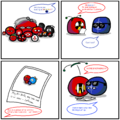 "What are you looking at Posadism?"
 -
"Leftist are fighting"
-
By u/cryaki on Reddit. Source

Navigation
| Canon |  Acid Communism • Acid Communism •  Agrarian Socialism File:Globnat.png Alter-Globalism • Agrarian Socialism File:Globnat.png Alter-Globalism •  Anarcho-Collectivism • Anarcho-Collectivism •  Anarcho-Communism • File:Anpacf.png Anarcho-Pacifism • Anarcho-Communism • File:Anpacf.png Anarcho-Pacifism •  Anarcho-Syndicalism • File:Anat.png Anationalism • File:Antifa.png Anti-Fascism • File:Auton.png Autonomism • File:BarrCom.png Barracks Communism • File:Circulus.png Circulus Theory • File:ClassSocDem.png Classical Social Democracy • File:Communization.png Communization Theory • File:Consocf.png Conservative Socialism File:Red Tory.png File:French RepublicanLeft LFI Party.png • File:Councom.png Council Communism • File:Cybercom.png Cybercommunism • File:Demsocstar.png Democratic Socialism File:Dsa.png • File:Aneco.png Eco-Anarchism • File:Ecosoc.png Eco-Socialism • File:Egocom.png Ego-Communism • File:Erga.png Ergatocracy • File:GeoSynd.png Geosyndicalism • File:Greensynd.png Green Syndicalism • File:Guildsoc.png Guild Socialism • File:Impossible.png Impossibilism • File:AnInde.png Independence Anarchism • File:Ismism Icon.png Ismism • File:LeftCom.png Italian Left Communism • File:Anmark2.png Left-Wing Market Anarchism • File:Leftnat.png Left-Wing Nationalism • File:Lpop.png Left-Wing Populism • File:Orthlen.png Leninism • File:Liberalsoc.png Liberal Socialism • File:Bckchn.png Libertarian Municipalism • File:Libsoc.png Libertarian Socialism • File:Mao.png Maoism • File:Marketsoc.png Market Socialism • File:Ormarxf.png Marxism • Anarcho-Syndicalism • File:Anat.png Anationalism • File:Antifa.png Anti-Fascism • File:Auton.png Autonomism • File:BarrCom.png Barracks Communism • File:Circulus.png Circulus Theory • File:ClassSocDem.png Classical Social Democracy • File:Communization.png Communization Theory • File:Consocf.png Conservative Socialism File:Red Tory.png File:French RepublicanLeft LFI Party.png • File:Councom.png Council Communism • File:Cybercom.png Cybercommunism • File:Demsocstar.png Democratic Socialism File:Dsa.png • File:Aneco.png Eco-Anarchism • File:Ecosoc.png Eco-Socialism • File:Egocom.png Ego-Communism • File:Erga.png Ergatocracy • File:GeoSynd.png Geosyndicalism • File:Greensynd.png Green Syndicalism • File:Guildsoc.png Guild Socialism • File:Impossible.png Impossibilism • File:AnInde.png Independence Anarchism • File:Ismism Icon.png Ismism • File:LeftCom.png Italian Left Communism • File:Anmark2.png Left-Wing Market Anarchism • File:Leftnat.png Left-Wing Nationalism • File:Lpop.png Left-Wing Populism • File:Orthlen.png Leninism • File:Liberalsoc.png Liberal Socialism • File:Bckchn.png Libertarian Municipalism • File:Libsoc.png Libertarian Socialism • File:Mao.png Maoism • File:Marketsoc.png Market Socialism • File:Ormarxf.png Marxism •  Marxism–Leninism File:ML-Alt.png • File:MLM.png Marxism–Leninism–Maoism File:MLM-Alt.png • Marxism–Leninism File:ML-Alt.png • File:MLM.png Marxism–Leninism–Maoism File:MLM-Alt.png •  Marxist Feminism • File:Minsocf.png Minarcho-Socialism • File:Monsoc.png Monarcho-Socialism • File:Monsynd.png Monarcho-Syndicalism • File:Mutalist.png Mutualism • File:Natan.png National Anarchism • File:Nazbol.png National Bolshevism • File:Natcom.png National Communism File:Natcom-Alt.png • File:Sorelia.png National Syndicalism • File:Neomarx.png Neo-Marxism • File:Partip.png Participism • File:Platformism.png Platformism • Marxist Feminism • File:Minsocf.png Minarcho-Socialism • File:Monsoc.png Monarcho-Socialism • File:Monsynd.png Monarcho-Syndicalism • File:Mutalist.png Mutualism • File:Natan.png National Anarchism • File:Nazbol.png National Bolshevism • File:Natcom.png National Communism File:Natcom-Alt.png • File:Sorelia.png National Syndicalism • File:Neomarx.png Neo-Marxism • File:Partip.png Participism • File:Platformism.png Platformism •  Posadism • File:Anqueer.png Queer Anarchism • File:Reactsoc.png Reactionary Socialism File:Reactionary Socialism.png • File:Bernst.png Reformist Marxism • File:Relsoc.png Religious Socialism • File:Ultraprogressivism.png Revolutionary Progressivism • File:Ricardosoc.png Ricardian Socialism • File:Situ.png Situationism • File:Socan2.png Social Anarchism • Socialism • File:Soc21.png Socialism of the 21st Century • File:Soctrans.png Socialist Transhumanism • File:Statesoc.png State Socialism • File:Strasser.png Strasserism • File:Synd.png Syndicalism • File:Synthesisanarchy.png Synthesis Anarchism • File:Totlib.png Total Liberationism File:Vegarch.png • File:Trot.png Trotskyism • File:Utsoc.png Utopian Socialism • File:Xenofeminism.png Xenofeminism Posadism • File:Anqueer.png Queer Anarchism • File:Reactsoc.png Reactionary Socialism File:Reactionary Socialism.png • File:Bernst.png Reformist Marxism • File:Relsoc.png Religious Socialism • File:Ultraprogressivism.png Revolutionary Progressivism • File:Ricardosoc.png Ricardian Socialism • File:Situ.png Situationism • File:Socan2.png Social Anarchism • Socialism • File:Soc21.png Socialism of the 21st Century • File:Soctrans.png Socialist Transhumanism • File:Statesoc.png State Socialism • File:Strasser.png Strasserism • File:Synd.png Syndicalism • File:Synthesisanarchy.png Synthesis Anarchism • File:Totlib.png Total Liberationism File:Vegarch.png • File:Trot.png Trotskyism • File:Utsoc.png Utopian Socialism • File:Xenofeminism.png Xenofeminism | ||
|---|---|---|---|
| Regional |  African Socialism • African Socialism •  Arab Socialism • File:Austrmarx.png Austromarxism • Arab Socialism • File:Austrmarx.png Austromarxism •  Ba'athism • File:Babouvism.png Babouvism • File:Lysnoir.png Black Lilyism • File:Blanqui.png Blanquism • File:Bolivarism.png Bolivarianism • File:Buddhist Socialism.png Buddhist Socialism • File:Bundis.png Bundism • File:Chavismo.png Chavismo • File:Christsoc.png Christian Socialism • File:Crusade of Romanianism.png Crusade of Romanianism • File:Deleon.png De Leonism • File:Demcon.png Democratic Confederalism • File:Dengf.png Dengism • File:TLeveller.png Diggerism • File:Ethcac.png Ethnocacerism • File:Eurocom.png Eurocommunism • File:Euskadi Carlism.png Euskadi Carlism • File:Fabian.png Fabian Socialism • File:Frankfurt.png Frankfurt School • File:Gaddafi.png Gaddafism • File:Ghandi.png Gandhian Socialism • Ba'athism • File:Babouvism.png Babouvism • File:Lysnoir.png Black Lilyism • File:Blanqui.png Blanquism • File:Bolivarism.png Bolivarianism • File:Buddhist Socialism.png Buddhist Socialism • File:Bundis.png Bundism • File:Chavismo.png Chavismo • File:Christsoc.png Christian Socialism • File:Crusade of Romanianism.png Crusade of Romanianism • File:Deleon.png De Leonism • File:Demcon.png Democratic Confederalism • File:Dengf.png Dengism • File:TLeveller.png Diggerism • File:Ethcac.png Ethnocacerism • File:Eurocom.png Eurocommunism • File:Euskadi Carlism.png Euskadi Carlism • File:Fabian.png Fabian Socialism • File:Frankfurt.png Frankfurt School • File:Gaddafi.png Gaddafism • File:Ghandi.png Gandhian Socialism •  Guevarism • File:Hoxha.png Hoxhaism • File:Hochi.png Ho Chi Minh Thought • File:Islamic Socialism.png Islamic Socialism • File:Juche.png Juche • File:Khrusch.png Khrushchevism • File:Labzion.png Labour Zionism • File:LiberationTheo.png Liberation Theology • File:Libpos.png Libertarian Possibilism • File:Makhaevism.png Machajskism • Guevarism • File:Hoxha.png Hoxhaism • File:Hochi.png Ho Chi Minh Thought • File:Islamic Socialism.png Islamic Socialism • File:Juche.png Juche • File:Khrusch.png Khrushchevism • File:Labzion.png Labour Zionism • File:LiberationTheo.png Liberation Theology • File:Libpos.png Libertarian Possibilism • File:Makhaevism.png Machajskism •  Mao-Spontex • Mao-Spontex •  Maoism–Third Worldism • File:Mariateguism.png Mariateguism • File:Mladorossi.png Mladorossism • File:Neosoc.png Neosocialism • File:Zapa.png Neozapatismo • File:Polpot.png Pol Potism • File:Prout.png Proutism • File:Sewersoc.png Sewer Socialism • File:Tito.png Titoism • Maoism–Third Worldism • File:Mariateguism.png Mariateguism • File:Mladorossi.png Mladorossism • File:Neosoc.png Neosocialism • File:Zapa.png Neozapatismo • File:Polpot.png Pol Potism • File:Prout.png Proutism • File:Sewersoc.png Sewer Socialism • File:Tito.png Titoism •  Tridemism Tridemism  • File:Vperedist.png Vperedism • File:Yellsoc.png Yellow Socialism • File:Vperedist.png Vperedism • File:Yellsoc.png Yellow Socialism | ||
| Fictional | File:Assoc.png Asocialism • File:Benefactor.png Benefactorism • File:Biopos.png Bio-Posadism • File:Capcom.png Capitalist Communism • File:Communalist.png Communalism • File:Esosoc.png Esoteric Socialism • File:Falgsc.png Fully Automated Gay Space Communism • File:Hmind.png Hive-Mind Collectivism • File:Ingsocf.png Ingsoc • File:Neobol.png Neo-Bolshevism • File:Soul.png Soulism • File:Strans.png Stransserism | ||
| Variants |
| ||


