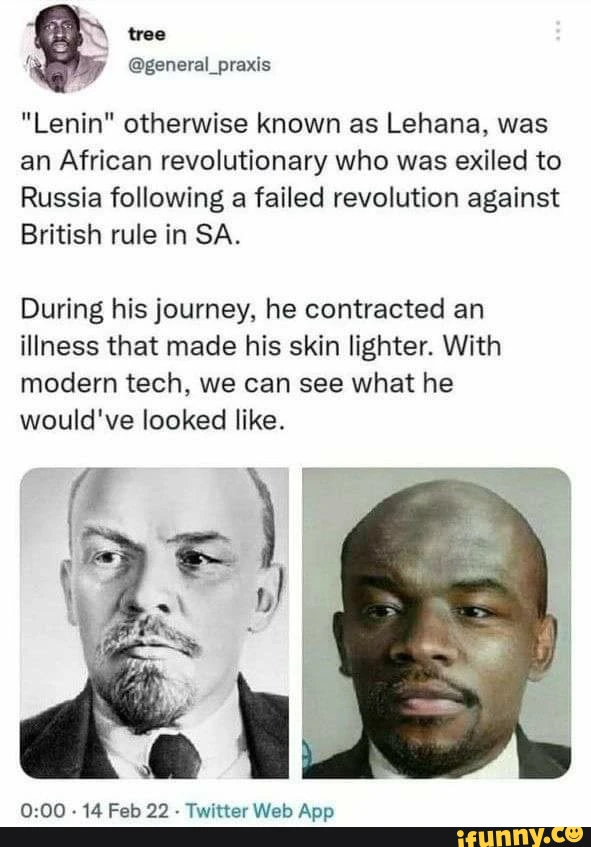
"A revolution is certainly the most authoritarian thing there is."
Leninism, also known as Orthodox Leninism or Bolshevism, is a  highly authoritarian, economically far-left
  socialist and
  communist ideology based on the beliefs of the
  Russian revolutionary and first leader of the Soviet Union
  Vladimir Lenin. He believes in the establishment of a
  Dictatorship of the Proletariat led by a
  Revolutionary Vanguard Party
  . He wants the full abolishment of private property and is in favor of socialist publicly owned property.
History
[edit]The Russian Revolution was a revolution that formed the first Marxist state by eliminating Tsar Nicholas II in 1917. Before the revolution, Russia was in a complicated situation, high social inequalities, lack of freedom, absolutism, extreme poverty, illiteracy, remnants of feudalism, backwardness compared to other countries, exhausting work with several hours and among countless other problems. One of the first oppositions emerged with the Russian Social Democratic Labor Party (RSDLP) of a Marxist and democratic socialist nature founded by Vladimir Lenin but ended up being considered illegal by the Empire, in which Lenin ended up fleeing to other European countries. Subsequently, the party split into two wings, the more radical Bolsheviks (Russian "Majority") and the more moderate Mensheviks (Russian "Minority").
The empire was already losing popularity among the people, in which there were protests in 1905 in Saint Petersburg, but it was violently repressed with the imperial guard shooting and killing hundreds, in what became known as Bloody Sunday. After the massacre, the people were furious against the tsar, culminating in the revolution of 1905, causing the tsar to create the Duma (parliament) as a way to alleviate the situation, allowing parties. Many historians claim that the revolution of 1905 was a "rehearsal" for that of 1917. In 1907, some revolutionaries were arrested or had to flee (like Lenin, again). way to calm the protests and increase patriotism against an outside enemy, but it was a disaster due to the high number of casualties and the death of 1,600,000-1,800,000 soldiers, destroying what was left of Russia (economy, infrastructure, quality of life, etc was completely destroyed), causing the tsar himself to command the army in 1915 leaving his wife to rule the country, in which they accused her of treason for being German and also of the Romanov family being influenced by  Grigori Rasputin, being assassinated in 1916. numerous protests, rebellions, and increased tensions, in which there was a demonstration in 1917, in which the guard was called to repress, but ended up allying with the protesters, which in March of the same year took place the Revolution of February (calendar difference), overthrowing the Tzar and the monarchs. A provisional government formed by the Duma and led by Alexander Kerensky was formed, in addition to the influence of the Petrograd Soviet (dual power). Kerensky's provisional government ended up granting amnesty to political prisoners and establishing democracy with a secret vote, but continued into World War I, in which at the behest of the German government to destabilize Russia, Lenin returned to Russia, promising "Peace, Land and Bread". ", that in October of the same year, there was the October Revolution, overthrowing the provisional government and Lenin taking power. The Bolsheviks became the communist party and took measures in this direction, in addition to exiting the First World War, which, even losing the elections, remained in power and repressed opponents (turning into a dictatorship).
Several opponents of Lenin, some ex-Mensheviks, pro-church and pro-empire formed the white army, while the communists formed the red army led by Leon Trotsky. The white army took most of the country (Siberia), but the whites had several internal divergences, the red army took the smallest part (the European part), but the was "better part", in which it had more industries, population, a better climate, etc. and it had few internal divergences. There were also Greens who were against everyone and wanted centrism and Blacks who were anarchists, who took Ukraine but later supported the Reds. There was also the execution of the Romanov family. Both sides committed massacres and atrocities, known as White Terror and Red Terror. There was the consolidation of the USSR, there were the so-called revolutionary courts that tried, arrested, or executed the "counter-revolutionaried".
After the civil war, Soviet Russia merged with other Soviet states, including the Ukraine SSR, and formed the  Soviet Union. The brutal civil war severely devastated the Russian economy and caused the The Great Russian Famine. Lenin saw the flaws of War Communism and realized that socialism could not be built in such a short time frame. He, therefore, enacted the
  New Economic Policy, which he described as “
 State Capitalism”. The NEP allowed small and medium enterprises to operate and allowed the existence of private property. This economic policy oversaw the restoration of pre-war production and sustained economic growth.
After the revolution, communism began to take influence, parties and movements in Europe, bringing the first red fear, eventually electing fascist and anti-communist leaders later. There are currently several debates and controversies regarding the Russian Revolution, with some extolling Lenin as a liberator of the oppressed from capitalism, others as a genocidal dictator who led the Russian people to misery and others considering him as a state capitalist because of the NEP.
Foundational Beliefs
[edit]Vanguardism
[edit]Lenin talks about the structure of a Vanguard in What is to Be Done[23]. The Vanguard is a structure to be taken by a social class (in this case, the Proletariat), in order to exert political power and force against the former oppressive class/classes (in this case, the Aristocracy and Bourgeoisie). This form of organization involves the most revolutionary minds of the class form organizations known as the revolutionary Vanguard, to gather in the great portion of the working class in a unified political movement. This organization serves the function of:
1) Organizing the Proletariat, by educating the masses and instilling revolutionary class consciousness in them.
2) Defending Marxism against reactionary forces and hostile political systems present, by a revolutionary organisation lead by the most class-conscious of the workers for organizational unity and coherence.
3) Via the process of Democratic Centralism, organize the party through professional revolutionaries so that the Vanguard can both defend itself from other classes and organize and coordinate the workers for the Revolutionary takeover of power.
He argued this form of organization was necessary because of the observation of the working class in Western Europe not developing revolutionary class consciousness in mass and explained this phenomenon based on the division of labor and long working hours of workers causing this to happen. Nevertheless, Lenin believed that the working class could be organized into a revolutionary force, and the necessary tool for this was an organization that could draw in the masses toward a unified and coherent struggle.
Theory of Imperialism
[edit]Leninism inspected considered Imperialism to be the highest stage of capitalism in which global monopolies and cartels primarily drive society. According to him, its five basic features were:
 Imperialism's balls
- The presence of monopolies which play a decisive role in economic life.
- The merging of bank capital with industrial capital into finance capital controlled by a financial oligarchy.
- The export of capital as distinguished from the simple export of commodities.
- The formation of international monopolist capitalist associations (cartels).
- The territorial division of the whole world among the biggest capitalist powers.
Leninism's conception of imperialism is therefore quite different from the typical conception of Imperialism.
Revolution and the Dictatorship of the Proletariat
[edit]wip
Women's Rights
[edit]Leninism heavily promotes equal rights for women,believing that Communism isn't possible without pushing for women's rights,with the Early Bolsheviks legalizing divorce and abortion while wanting to emancipate women from housework
Views on Other Ideologies
[edit]wip
Variants
[edit] Bukharinism/Right Opposition
[edit]
Nikolai Bukharin (1888–1938) was one of the most prominent intellectuals and political leaders of the early Soviet state. A member of the Bolshevik movement before the Russian Revolution, Bukharin became known both for his theoretical contributions to Marxist thought and for his role in debates over the economic and political direction of the Soviet Union. The ideas later associated with the Right Opposition within the Communist Party developed gradually through the major political conflicts of the revolutionary and early Soviet period.
Bukharin entered revolutionary politics as a young Marxist activist in the Russian Empire. During his early years in exile in Western Europe, he engaged with different currents of socialist thought and became particularly interested in the revolutionary debates taking place among  Marxists across the continent. In these years he interacted with figures connected to
  radical socialist theory and developed an interest in philosophical ideas that ranged widely beyond orthodox Marxism. By the time of the Russian Revolution, Bukharin had already become one of the more intellectually
  adventurous members of the Bolshevik movement.
After the revolution, Bukharin quickly rose within the leadership of the new Soviet government. He worked closely with Vladimir Lenin and became editor of the party newspaper Pravda. In the early 1920s, as the country struggled to recover from civil war and economic collapse following the Russian Civil War, Soviet leaders debated how to rebuild the economy. Bukharin became one of the most prominent defenders of the New Economic Policy, which allowed limited market activity and private enterprise within a socialist state framework.
Bukharin argued that the policy would gradually strengthen the economy and allow socialism to develop without forcing immediate and disruptive transformation in agriculture and industry. His speeches during this period famously encouraged peasants to “enrich yourselves,” reflecting his belief that a gradual increase in rural prosperity could stabilize the Soviet system and encourage voluntary cooperation between peasants and the socialist state. This approach placed him in opposition to leaders who favored more rapid and coercive economic transformation.
During the power struggles that followed Lenin’s death in 1924, Bukharin initially aligned himself with Joseph Stalin against the political faction led by  Leon Trotsky. In these debates Bukharin criticized Trotsky’s proposals for rapid industrialization and permanent revolutionary expansion abroad, arguing instead that the Soviet Union needed a
  stable internal economic strategy. His views supported the idea that socialism could be consolidated within a single country while the Soviet economy developed gradually through mixed mechanisms that included both planning and controlled market activity.
However, the political landscape shifted dramatically at the end of the 1920s. Stalin abandoned the gradual approach associated with Bukharin and instead launched rapid industrialization and forced collectivization of agriculture. Bukharin openly  criticized these policies, warning that coercive collectivization would damage agricultural productivity and alienate the peasantry. These disagreements led to a bitter conflict within the Communist Party. Bukharin and his allies were eventually marginalized, forming what later historians called the Right Opposition.
By the late 1930s, Bukharin had lost nearly all political influence. During the period of political repression known as the Great Purge, he was arrested, accused of participating in conspiracies against the Soviet state, and subjected to a highly publicized trial. In 1938 he was executed, becoming one of the most prominent victims of the purges that reshaped the Soviet leadership.
In retrospect, Bukharin’s political outlook came to represent a distinctive strand of Soviet socialist thought. His approach emphasized gradual economic development, the coexistence of limited market mechanisms within a socialist system, and caution toward policies that relied heavily on coercion. The debates surrounding his ideas—particularly those concerning the New Economic Policy, the role of the peasantry, and the pace of socialist transformation—remain among the most significant ideological disputes in the history of the Soviet Union.
 Mayakovskyism
[edit]
Vladimir Mayakovsky (1893–1930) was one of the most influential cultural figures of the early Soviet period. Known primarily as a poet, playwright, and artist, he became closely associated with the artistic and political upheaval that followed the collapse of the Russian Empire and the rise of the Soviet state.
Mayakovsky’s early life unfolded during a time of political unrest in the Russian Empire. As a young man he became involved in revolutionary circles and was briefly imprisoned for his participation in underground political activity. During these years he began exploring avant-garde art movements that rejected traditional literary styles and cultural hierarchies. His creative development soon brought him into contact with the Russian branch of  Futurism, an artistic movement that sought to break with the past and celebrate modern technology, urban life, and revolutionary change. Futurist artists believed that art should actively reshape society rather than merely reflect it, an idea that strongly influenced Mayakovsky’s worldview.
Before the revolution, Mayakovsky participated in Futurist exhibitions and performances that challenged conventional culture and authority. These events often used shocking language, dramatic performances, and unconventional typography to provoke audiences and disrupt established artistic norms. Through these actions he demonstrated a tendency toward  questioning rigid authority structures in both art and society, though he still believed revolutionary movements were necessary to create a new social order.
The Russian Revolution transformed Mayakovsky from an avant-garde provocateur into a cultural voice of the revolutionary state. Rather than retreating into purely literary work, he devoted his talents to the political transformation taking place around him. Mayakovsky believed that artists had a responsibility to help shape the future society envisioned by the revolution, and he sought to make poetry, theater, and visual design instruments of social mobilization.
One of the most distinctive aspects of his work during this period was his engagement with mass communication. Mayakovsky collaborated with the Soviet state’s propaganda efforts, producing posters, slogans, and illustrated messages that were distributed across the country. Much of this work took place through the  ROSTA Windows, a propaganda project organized by the Russian Telegraph Agency. These visual posters combined bold imagery with short, rhythmic slogans designed to communicate political messages quickly to a largely illiterate population. Through this work Mayakovsky helped pioneer a style of political communication in which artists and media creators played a central role in shaping public discourse.
In literature and theater, Mayakovsky continued experimenting with form and language. His poems frequently celebrated industrialization, urban energy, and technological modernity while attacking what he saw as stagnation, conservatism, and cultural backwardness. Works such as The Bedbug and The Bathhouse satirized bureaucratic inefficiency and social complacency, reflecting his frustration with elements of the Soviet system that he believed were drifting away from the revolutionary spirit that had inspired him.
Despite his support for the revolution, Mayakovsky sometimes found himself at odds with emerging cultural authorities who favored stricter ideological control over artistic production. His insistence on creative experimentation and his willingness to criticize bureaucratic rigidity created tension with more orthodox cultural institutions. This placed him in a complicated position: he remained committed to the  revolutionary project while also resisting the idea that artistic expression should be tightly constrained by official doctrine.
Throughout the 1920s, Mayakovsky continued to promote the idea that art should actively participate in shaping a new and progressive society. He saw the poet not simply as an observer but as an engineer of social consciousness, someone capable of inspiring people to embrace modernity and revolutionary transformation. His public performances, lectures, and published works helped make him one of the most recognizable cultural figures of the early Soviet era.
Mayakovsky’s life ended tragically in 1930, but his influence persisted in Soviet literature, avant-garde art, and revolutionary cultural theory. His career demonstrated how artistic innovation, mass communication, and political commitment could merge into a single creative project aimed at transforming society itself.
 Sverdlovism
[edit]
Yakov Sverdlov (1885–1919) was one of the most important organizational figures of the early Bolshevik movement and the emerging Soviet state. Although his life was short, his influence on party discipline, revolutionary administration, and the political structure of the new government was considerable.
Sverdlov was born in Nizhny Novgorod during the final decades of the Russian Empire, a time when the autocratic government of Nicholas II faced growing revolutionary opposition. As a young activist, Sverdlov became involved with the revolutionary underground and joined the Bolshevik faction of the Russian Social Democratic movement. His early political work centered on organizing workers and building clandestine party networks dedicated to overthrowing the tsarist monarchy. During these years he became known for his  uncompromising hostility toward the aristocratic social order that dominated imperial Russia and for his rejection of the limited
  parliamentary reforms introduced after the 1905 revolution.
Much of Sverdlov’s early revolutionary career was spent under surveillance, imprisonment, or internal exile in remote parts of the empire. Despite these obstacles, he developed a reputation within the Bolshevik movement as a disciplined and highly effective organizer. By the time of the February Revolution and the subsequent collapse of the  Romanov monarchy, Sverdlov had become one of the most trusted associates of Vladimir Lenin.
Following the October Revolution, Sverdlov assumed a crucial role in shaping the internal structure of the new  Soviet government. As chairman of the All-Russian Central Executive Committee, he effectively functioned as one of the highest-ranking officials in the emerging political system. His work focused heavily on coordinating party institutions, enforcing discipline among revolutionary cadres, and strengthening the authority of central leadership during the fragile early period of Soviet rule.
The early Soviet state faced enormous challenges, including civil war, economic collapse, and armed opposition from anti-Bolshevik forces. During the Russian Civil War, Sverdlov played a major role in organizing the administrative machinery that supported the Bolshevik war effort. The Soviet government relied heavily on  centralized coordination of resources, strict party discipline, and
  military mobilization to maintain control over territory and suppress opposition. These circumstances helped produce a political environment in which military authority, revolutionary committees, and centralized command structures were deeply intertwined.
During the war years the Bolshevik government also adopted drastic economic measures to sustain the Red Army and maintain political control. These policies became known as  War Communism. The system involved state control of industry, requisitioning of agricultural goods, and strict regulation of economic activity. Sverdlov, as a senior party administrator, played a key role in implementing and coordinating these policies through the party’s growing network of local authorities.
The revolutionary government also relied on propaganda and communication networks to maintain political support during the chaotic war period. Party publications, public speeches, and official proclamations helped disseminate revolutionary messages across the country. Sverdlov’s organizational leadership ensured that these channels were coordinated with party directives, linking communication, political authority, and mobilization of the population in support of the revolutionary project.
Another aspect of Sverdlov’s work involved managing the  complex ethnic and national landscape of the former Russian Empire. The early Soviet government attempted to integrate numerous nationalities into the new political system while maintaining centralized authority in Moscow. Party administrators under Sverdlov’s leadership worked to organize local soviets and revolutionary committees in diverse regions, attempting to reconcile national diversity with the unified structure of the Bolshevik state.
During the harsh conditions of civil war, the revolutionary leadership also endorsed  severe measures against perceived enemies of the new regime. Revolutionary tribunals, security forces, and emergency powers were employed to suppress counterrevolutionary activity and stabilize the government’s control. These practices reflected the belief among many Bolshevik leaders that extraordinary measures were necessary to defend the revolution during a period of existential conflict.
Sverdlov’s career was cut short in 1919 when he died during the civil war period. Despite his brief life, his administrative methods and organizational approach helped shape the structure of the early Soviet political system. His emphasis on disciplined party coordination, centralized authority, and the mobilization of revolutionary institutions left a lasting imprint on how the Bolshevik state functioned during its formative years.
Personality
[edit]- Wears Lenin's famous iconic cap
- Heavy
 Russian accent
 - Cynical attitude
- Very radical, uncompromising, militant, and revolutionary
- "That's got to be the best populist leader I've ever seen"
- Likes cats
- Also likes total party control, total ideological control, forced collectivism, unquestioning obedience, and rigid centralized top-down power structures and hierarchies
with himself at the top - Dislikes any deviation from the party line or criticism
- Also dislikes class enemies
(a "class enemy" is whoever the party line says it is) - Pretty much the opposite of left unity. If another leftist doesn't align enough with him, his positions and his policies, expect him to call that leftist a plethora of archetypical
 AuthLeft insults, such as "opportunist", "philistine", "bourgeois", "petit-bourgeois", "revisionist", "rightist", etc.

How to Draw
[edit]
Leninism's design is based on the flag of the Russian Soviet Federative Socialist Republic between the years 1918 to 1927 when Vladimir Lenin was its leader.
- Draw a ball with eyes and fill it red.
- Add a Horizontal red rectangle with a yellow border in the top left corner.
- Add the Russian letters 'РсФсР' in the rectangle.
- (Optional) Draw Lenin’s cap.
| Color Name | HEX | RGB | |
|---|---|---|---|
| Red | #CC0000 | rgb(204, 0, 0) | |
| Gold | #FFD700 | rgb(255, 215, 0) | |
Relations
[edit]Товарищи (Comrades)
[edit] Марксизм - Greatly inspired me and taught me a lot of stuff. I greatly thank him and admire him!
 Левый популизм - Land to the Peasants! Factories to the Workers! Peace to the People! Power to the Soviets!
 Though most of your modern proponents are mensheviks or even dirty succdems. Итальянский левый коммунизм - Your criticism of Turati and the others reformists was correct, but your conclusion from said criticism was wrong.
 Авангардизм - Democratic Centralism by the worker's soviets is the way to go.
 Эргатократия - Every cook must learn how to govern the state!
 КПК
КПК  - Our Chinese comrades must join the
  Kuomintang to fuel the fires of a communist revolution in the future.[24]
 Республиканизм - Death to the Romanovs, long live the Soviet Republics!
 Якобинизм - Just like how you ended the Ancien Regime, so to I ended the Tsarist autocracy.
- Марксизм-ленинизм - My most influential son who brought the revolution to the next stage and spread it to the whole world.
 Стратократия - Red Army is the strongest.
 марксистский феминизм - Women should be our equals. We had the first female cabinet member in modern history and legalized abortion and divorce. I also designated March 8 to be Women's International Day.


Люмпен-пролетариат (Lumpenproletariat)
[edit] Троцкизм - While I appreciate you leaving the Mensheviks for me, and your competent leadership of the military in the Civil War, a lot of your essays were half-Menshevik and quite wrong.
- Бухаринизм - While you were an important and quite possibly the favorite theorist of the party, you never were able to grasp dialectics.
 Зиновьевизм - It was no accident when I called you a deserter. However that was as important as Trotskys non-Bolshevism.
 Сталинизм - While you were an old and important member of the Bolshevik party, why did you purge the Old Bolsheviks and not listen to Tukhachevsky's orders in the Polish-Soviet War?!? However, you did manage to industrialize the Soviet Union and defeat fascists, so good job there.
 Юлий Мартов - You and I were friends, but your political views are nothing but philistine ramblings.
 Классическая социал-демократия - The old proletarian SPD was the model I used for the Bolshevik party, and I like Rosa, but she was critical of me, and I had to deal with the Mensheviks because their soviets opposed my vanguard party.
 НЭП (Post-revolution) - Look, I'm going to use you as a means to an end.
 Карл Каутский - You influenced me in the 2nd International. However, you have become nothing but a renegade after the 1st World War.
 Because you abandoned your ideas that I still defended. Кемализм - We helped you in the Turkish war of independence and you are a fellow anti-imperialist and a progressive. But you aren't a supporter of communism. Why? Don't you know the best way to fight imperialism is communism?
- Три Народных Принципа - A revolutionary democrat, endowed with nobility and heroism. Although you were not a fan of Marxism.
 Идеи Вильгельма II - Reactionary German imperialist. Thanks for the train back to Russia though.
 Демократический социализм - Menshevik scum! (I respect the
  Rosa Luxemburg supporters in your party tho). Also, your British version is FAR better.
 Национал-коммунизм - The proletariat knows no country. But I promoted several patriotic socialists into key party positions in Ukraine.


Буржуазия и дворянство (Bourgeoisie and nobility)
[edit] Николай II - I still remember when I shot you, your family and your servants ХАХАХА! Good riddance scum.
 Белая армия - The White Army and the Black Baron are preparing to restore to us the Tsar's throne, but from the taiga to the British seas, the Red Army is the strongest of all!
 Конституционный монархизм - The 1906 constitution was a half-measure by the Tsar designed to divert support.
 Социалистический революционизм - Stop blaming me for banning Left SRs: we tried to work together, but then they attempted to coup me!
 Монархо-социализм - What?
 Реформистский марксизм - Philistine! Renegade! Opportunist! You think that you can transform the bourgeois state into a proletarian one, disgusting! In order to seize the means of production revolution is a must!
 Детская болезнь "левизны" в коммунизме - What "Left-wing" rubbish! You are correct about the state and I prefer you over K*utsky.
 Капитализм - You are the enemy of the people! One day the workers will once again rise against you, filthy kulak! Mark my words!
 Аристократия - Same with you.
 Империализм - The highest stage of Capitalism.
 Фашизм - Ah yes, Fascism. The building blocks for pretty much most cancerous ideologies. You need to step into the pit for once.
 Нацизм - You aren’t a socialist. You just made up your own ideology with inspirations from Fascism and called yourself Socialism, German Fascism is what you truly are.
 Черносотенство - Tsarist AND Fascist? Get the bullet, reactionary scum! Also, Korenizatsiya goes brrrr, stay mad,
  Great Russian Chauvinist.
 Путинизм - I did not invent Ukraine, you chauvinist. I still don't get why my
  great-great-grandson kinda likes you.
-
 Then why did you literally say you did, just now?


 Социал-демократия - Opportunist! Also, shame on you to be indifferent to witness
  Stratocracy murder
  Rosa!
Rosa! Реакционный социализм - A relic of the past, Feudalism's sad attempt to co-opt socialism to restore itself.
 Анархо-коммунизм - Petit-bourgeois naïve anarkiddy. We failed to cooperate unsurprisingly. You and your Utopian Socialism dreams are good but shall never happen!
 Бланкизм - We have always heard a chorus of accusation that we were too inflexible and ossified, too adamant. And yet our opponents call us “Blanquists”, “anarchists” and “true socialists”. The Blanquists are conspirators (they have never been in favour of the general strike), they exaggerate the importance of revolutionary government.
 Впередизм - A counterrevolutionary idiot who serves nothing more as a factionalist and thorn. Although more good ideas than bad, but how can you think that the peasants have no role in the revolution!?
 Национал-либерализм - Native bourgeoisie tool for conquering with sword and fire new markets for the national industry.[25]
 Венизелизм - Social fascist version of above who tried to destroy me in his country.
 Национал-большевизм - Counter-revolutionary scums! I exiled Ustryalov for being an opportunist who worked with Kolchak.[26]
 Младороссизм - Annoying reactionary monarchist LARPer who really likes me for some reason. Stalin was right to send you and your supporters to the Gulag.
 Белый национализм - Reactionary rats that make conspiracy theories of me being a Judeo-Bolshevik or whatever.
 Консерватизм and
  Реакционизм - Counter-revolutionaries.
 Консервативный социализм - A bourgeoisie socialist and a talist.
 Национализм - I oppose nationalism as it divides the working class.
 Санационизм - Reactionary nationalist scum.


Further Information
[edit]Literature
[edit]Works by Vladimir Lenin
[edit]- Imperialism, the Highest Stage of Capitalism
- "Left-Wing" Communism: An Infantile Disorder
- The State And Revolution
- What Is To Be Done?
- Lenin's Philosophical Notebooks
- The Right of Nations to Self-Determination
- The Proletarian Revolution and the Renegade Kautsky
- The Emancipation of Women
- Essential Works of Lenin
- Economics And Politics In The Era Of The Dictatorship Of The Proletariat
Works by other Writers
[edit]- Leninism by Neil Harding
- Lenin Rediscovered: What is to be Done? In Context by Lars T. Lih
 Wikipedia
[edit]
 Vladimir Lenin
 Leninism
- Vanguardism
 Democratic Centralism
- Russian Social Democratic Labour Party
- Russian Revolution of 1905
- February Revolution
- Russian Constituent Assembly
- Dual Power
 Anatoli Zhelezniakov
 Bolshevik Party
- Bolshevism
- Russian Revolution
- October Revolution
- Russian Civil War
- Murder of the Romanov family
 Cheka
Cheka Red Terror
 War Communism
 Polish–Soviet War
- Finnish Civil War
- Russian famine of 1921–1922
 Korenizatsiia
- NEP
 Valery Sablin


Videos
[edit]- Lenin: What man is the monument erected on your square dedicated to? by Maxim Katz (In Russian)
- What is Leninism? by Viki 1999
- The Russian Revolution by Oversimplified (Part 1 and Part 2)
- The Russian Revolution by Simple History
References
[edit]- ↑ Pejoratively, in Russian-speaking countries. "Членин" - a portmanteau of "Lenin" and "Член" ("Dick"). Literally "Dicklin".
- ↑ 2.0 2.1 "Lenin is smart, and he was a good writer (though I don't agree with everything that he said), um, he's also a monster. Basically, there are two Lenins: Lenin pre-revolution and Lenin post-revolution. Pre-revolution, when he was doing his writing, y'know, not all of it, when he was doing some writing, y'know, there's some valuable stuff there. Post-revolution, he was an authoritarian, he immediately cracked down on workers' councils, executed political enemies, like instantly, when Lenin achieved power, he became like... Like, people distinguish between Stalin and Lenin, as though Stalin was, like, the crazy one who took over and ruined everything - but that's not really true. Lenin set everything in motion for what Stalin would later become." -
 Ian "Vaush" Kochinski, A Moron's 101 Guide to Marxism Ft. PragerU
- ↑ Black Lenin
- ↑ Lenin's speech on antisemitism, scapegoats and a divided working class. 1919
- ↑ https://en.wikipedia.org/wiki/Cult_of_personality#Soviet_Union
- ↑ Lenin's views on imperialism were influenced by Rudolf Hilferding.
- ↑ https://theanarchistlibrary.org/library/maximoff-the-political-philosophy-of-bakunin
- ↑ https://www.marxists.org/archive/lenin/works/1917/staterev/ch06.htm#s3
- ↑ https://www.researchgate.net/publication/254624250_The_Influences_of_Chernyshevsky_Tkachev_and_Nechaev_on_the_political_thought_of_VI_Lenin
- ↑ https://en.wikipedia.org/wiki/Polish%E2%80%93Soviet_War
- ↑ https://en.wikipedia.org/wiki/Soviet_invasion_of_Georgia
- ↑ https://en.wikipedia.org/wiki/Bolshevik%E2%80%93Makhnovist_conflict#Red_Terror
- ↑
https://www.marxists.org/archive/lenin/works/1906/dec/20.htm - ↑ https://www.marxists.org/archive/lenin/works/1899/mar/kautsky.htm
- ↑ https://www.marxists.org/archive/lenin/works/1905/mar/23.htm
- ↑ https://www.trevorloudon.com/2019/07/lenins-hero-nechayev-the-evilest-communist-who-ever-lived/#:~:text=Lenin%20himself%20was%20highly%20influenced%20by%20Nechayev%2C%20often,urged%20all%20communist%20revolutionaries%20to%20read%20his%20work.
- ↑ https://www.researchgate.net/publication/254624250_The_Influences_of_Chernyshevsky_Tkachev_and_Nechaev_on_the_political_thought_of_VI_Lenin
- ↑ https://www.researchgate.net/publication/254624250_The_Influences_of_Chernyshevsky_Tkachev_and_Nechaev_on_the_political_thought_of_VI_Lenin
- ↑ https://www.marxists.org/archive/lenin/works/1914/cons-logic/index.htm
- ↑ https://www.marxists.org/archive/lenin/works/1915/misc/x01.htm
- ↑ The system has often been described as simple authoritarian control by the ruling and military castes to maintain power and control in the Soviet regions, rather than any coherent political ideology. The Soviet propaganda justified it by claiming that the Bolsheviks adopted this policy with the goal of keeping cities (the proletarian power-base) and the Red Army stocked with food and weapons since circumstances dictated new economic measures.
- ↑ "As for myself, I am merely a pupil of Lenin, and my aim is to be a worthy pupil of his." -
 Joseph Stalin, An Interview with the German Author Emil Ludwig
- ↑ https://www.marxists.org/archive/lenin/works/1901/witbd/
- ↑ https://en.wikipedia.org/wiki/First_United_Front
- ↑ https://www.marxists.org/archive/lenin/works/1912/dec/22.htm
- ↑ https://www.marxists.org/archive/lenin/works/1922/mar/27.htm

Gallery
[edit]Portraits
[edit]-

-

-
 Old portrait


Alternative designs
[edit]-
 Biological Leninism
 -
Biological Leninism
-
 War Communism
 -
 Flag of Biological Leninism
 -
 Flag of War Communism


Comics and Artwork
[edit]-
 Credit: Moonatik
 -

-
 Credit: bruno-radical
 -
 By AquaHeart


Navigation
[edit]| Main Ideologies |  African Socialism • African Socialism •  Arab Socialism • Arab Socialism •  Ba'athism • Ba'athism •  Barracks Communism • Barracks Communism •  Benefactorism • Benefactorism •  Bio-Posadism • Bio-Posadism •  Bolivarianism • Bolivarianism •  Chavismo • Chavismo •  De Francism • De Francism •  Esoteric Socialism • Esoteric Socialism •  Ethnocacerism • Ethnocacerism •  Gaddafism • Gaddafism •  Guevarism • Guevarism •  Hoxhaism • Hoxhaism •  Hive-Mind Collectivism • Hive-Mind Collectivism •  Jacobinism • Jacobinism •  Juche • Juche •  Kemalism • Kemalism •  Khrushchevism • Khrushchevism •  Lawsonomy • Left Communism • Lawsonomy • Left Communism •  Left-Wing Nationalism • Left-Wing Nationalism •  Leninism • Leninism •  Longism • Longism •  Maoism • Maoism •  Maoism–Third Worldism • Maoism–Third Worldism •  Marxism–Leninism Marxism–Leninism  • •  Marxism–Leninism–Maoism Marxism–Leninism–Maoism • •  Mladorossism • Mladorossism •  Monarcho-Socialism • Monarcho-Socialism •  Monarcho-Syndicalism • Monarcho-Syndicalism •  National Bolshevism • National Bolshevism •  National Communism National Communism  • •  National Syndicalism • National Syndicalism •  Neosocialism • Neosocialism •  Peronism • Peronism •  Pol Potism • Pol Potism •  Populareism • Populareism •  Posadism • Posadism •  Social Authoritarianism • State Socialism • Social Authoritarianism • State Socialism •  Stransserism • Stransserism •  Strasserism • Strasserism •  Titoism • Titoism •  Trotskyism • Trotskyism •  Vperedism • Vperedism •  Yellow Socialism Yellow Socialism | ||||||
|---|---|---|---|---|---|---|---|
| Variants |
| ||||||