Wiki is in the process of importing stuff
Please be patient
"Spain has no foolish dreams."
Francoism is an File:Sec.png authoritarian, File:Reactcross.png reactionary, and File:Ultranat.png ultranationalist ideology that is based upon the ideals and political beliefs of the File:Cball-Spain.png Spanish dictator File:Franco-alt.png Francisco Franco, who ruled from the end of the Spanish Civil War in 1939 until his death in 1975.
History
[edit]Origins
[edit]It all started in 1936 during the beginning of the Spanish civil war. File:Franco-alt.png Franco emerged as the dominant rebel military leader and was proclaimed Head of State on 1 October 1936, ruling a dictatorship over the territory controlled by the Nationalist faction. The 1937 Unification Decree, which merged all parties supporting the rebel side, led to Nationalist Spain becoming a single-party regime under the File:Flang.png FET y de las JONS
After the civil war
[edit]At the end of the civil war, the nationalists won and Franco became dictator of all of Spain. WW2 then broke out, and Spain did not join the Axis powers (File:Nazi.png Germany, File:Showa.png Japan and File:Fash.png Italy) because of how war-torn the country was—or at least that was Franco’s alibi. Then the 1947 Law of Succession made Spain a de jure "Kingdom" again but it wasn't. Reforms were implemented in the 1950s and Spain abandoned autarky, kicked out the File:Flang.png Falangist movement, which had been prone to isolationism, to a new breed of economists, the technocrats of Opus Dei. This led to massive economic growth, second only to Japan, that lasted until the mid-1970s, known as the "Spanish miracle". In 1955 Spain joined the United Nations and Franco was one of Europe's most outspoken anti-communist figures: his regime was assisted by the Western powers, particularly the United States, and it asked to join NATO.
File:StratoHelm.pngLuis Carrero Blanco
[edit]Luis Carrero Blanco emerged as one of the most loyal and influential figures within the Francoist regime in Spain, serving as a close confidant of Francisco Franco and eventually becoming Prime Minister in 1973. His political formation was rooted in the aftermath of the Spanish Civil War, where the Nationalist victory established a regime built on File:Anticommunism.pnganti-communism, File:Mil.pngmilitarism, and strong centralized authority. Carrero Blanco’s early career in the navy and his alignment with Franco’s inner circle positioned him as a key architect of regime continuity, particularly in maintaining ideological rigidity against perceived leftist threats.
His commitment to anti-communism defined much of his political activity. Throughout his tenure, Carrero Blanco supported the suppression of leftist movements, trade unions, and political opposition, viewing communism as both a domestic and international threat. This position was closely tied to the Cold War context, where the Francoist state framed itself as a bulwark against Soviet influence. His writings and internal communications reveal a consistent belief that political stability depended on eliminating ideological pluralism, reinforcing the authoritarian nature of the regime.
At the same time, Carrero Blanco’s worldview was deeply shaped by File:Catheo.pngCatholicism, particularly the traditionalist interpretation embedded in Francoist ideology. The regime’s alignment with the Catholic Church informed policies on education, social order, and governance, reflecting elements of File:Heart-Integralism.pngintegralism, where religious doctrine and state authority operate in close partnership. Carrero Blanco supported this fusion, advocating for a moral and hierarchical society guided by religious principles, which he believed would ensure national unity and cultural continuity.
Economically, his position evolved within the framework of Francoist development. While early Francoism emphasized autarky, Carrero Blanco later supported elements of File:Corptism.pngcorporatism and File:Nazcap-Hat.pngnational capitalism, where the state coordinated economic activity through controlled institutions while allowing limited private enterprise. This approach aimed to balance modernization with political control, preventing independent economic actors from challenging state authority. His support for technocratic governance also contributed to what can be described as File:TechnoAbMon.pngtechnocratic monarchism, where experts and administrators would guide economic and political policy under an authoritarian framework that anticipated the restoration of the monarchy.
Carrero Blanco’s political outlook also included support for File:Imp.pngimperialism, particularly in the context of maintaining Spain’s remaining colonial possessions during the mid-twentieth century. His stance reflected a broader belief in Spain’s historical mission and national prestige, aligning with Francoist narratives of continuity with imperial traditions. This perspective reinforced his commitment to a strong, centralized state capable of projecting power both domestically and internationally.
His career ultimately ended with his assassination in 1973 by the Basque separatist group ETA, an event that exposed vulnerabilities within the regime’s security apparatus and disrupted Franco’s plans for political succession. Carrero Blanco had been intended as a stabilizing figure who would preserve the ideological foundations of Francoism after Franco’s death. His removal accelerated internal tensions and contributed to the eventual transition away from authoritarian rule.
Death of Franco
[edit]Franco died in 1975 at the age of 82. He restored the monarchy before his death and made his successor File:JuanCarlosI.png King Juan Carlos I, who would lead the Spanish transition to File:Dem.png democracy. This would be the end of Francoism in Spain.
Neo-Francoism
[edit]Neo-Francoism is a term used to designate positions that support Francoism or its ideals after Franco's death. Some parties that could fall into this category are España 2000 or Democracia Nacional, categorized as neo-fascist and extreme right-wing.
Some media have used this term to refer to extreme right-wing or conservative movements.
File:PostFrancoism.png Sociological Francoism/Post-Francoism
[edit]Sociological Francoism (also called Post-Francoism) refers to the political ideas of Francisco Franco that continue to prevail in Spanish society and politics after his death.
Mainly this can happen due to the support of ideas that the caudillo mainly defended as File:Sec.png Authoritarianism, File:Catheo.png National Catholicism File:Nation.png, File:Strato.png Militarism, File:Technocracy.png Technocracy and other ideals, but also this can be expressed with phrases like "Con Franco vivíamos mejor" (With Franco we lived better) and "Esto con Franco no pasaba" (This with Franco didn't happen) in a sarcastic or serious way.
Beliefs
[edit]Ideological Roots
[edit]Francoism believes in File:Sec.png Authoritarianism, File:Anticommunism.png Anti-Communism, File:Cball-Spain.png unitarian Spanish nationalism and File:Catheo.png National Catholicism File:Nation.png, it sought Spain to become a monarchy to appease File:Reactcross.png reactionaries with the 1947 Law of Succession made Spain a de jure kingdom, heavily utilizing imagery and concepts that reference the Catholic Kings of Old Spain in order to praise them as national symbols of true Spanish identity (while Franco's government wasn't a monarchy itself but instead a personalized dictatorship), File:Strato.png Militarism, File:Ultranat.png Ultranationalism,. It also believes File:Anti-Masonry.png in extreme Anti-Masonry, anti-separatism, and anti-parliamentarianism. Despite its deeply ideological governance, it advocates for a File:Technocracy.png non-ideological cabinet based on skill.
Some say that it's also a Spanish variant of fascism, but this is disputable. While it had a close relationship with Italian and German fascist ideologies and shared similar aesthetics, it arguably isn't fascist itself in the traditional sense, especially after WWII ended. Rather, it became more of a spiritual predecessor for the far-right South American juntas of the '70s (Pinochet, Stroessner, Videla...) mainly due to its pioneering of the "developmental state" (a regime which synthesizes high authoritarianism, revivalist nationalism and social File:Ultracon.png ultraconservatism with broadly technocratic economic liberal policies).
File:Internation.png Foreign Relations
[edit]Initially Franco maintained very close relations with other nationalist countries like Nazi Germany, Vichy France and Kingdom of Italy, even sending the falangist volunteers of the Azul division to fight on the eastern front against the Soviets, however he recalled them in Spain when it was clear that the war was lost and always resisted pressure from Hitler and Mussolini to fully join the conflict, even refusing to hand over the Jews to the Germans. Churchill, like many British Tories, did not have a high opinion of the Spanish republicans and described Franco as a "Christian gentleman", even offering millions of dollars to his generals so that they would not turn against the allies. Franco never did anything to conquer Gibraltar.
Although towards the end of WW2 Franco had changed Spain's status to neutrality (compared to the initial pro-Axis non-belligerence), the Allies continued to isolate him in the early years, seeing him as a friend of the fascists and some even called for the overthrow of one of the last authoritarian regimes in Western Europe, which did not happen. Nationalist Spain was only able to join the UN in 1955 and was excluded from the Marshall Plan, suffering for many years from isolationism, stagnation and poverty. With the intensification of the Cold War, the United States saw in Franco's Spain, increasingly seen as a conservative Catholic anti-communist open to market reforms rather than a fascist totalitarian ultranationalist, a potential ally against the USSR and relations relaxed significantly, even leading to the opening of US military bases in Spain, although there was no entry into NATO (which occurred after the democratic transition). Despite increasingly improving relations with the West, Franco's policy could still differ from that of Washington on some issues concerning the Middle East, for example good relations were maintained with Arab countries such as Nasser's socialist Egypt and relations with Israel were always mostly poor, with the Israelis hating the regime and trying to isolate it (fiercely opposing entry into the UN) and the Spanish cultivating closer relations with the Palestinians in response.
Franco maintained an anti-communist and pro-Western attitude regarding the Vietnam War, supporting the Americans and the South Vietnamese with aid, however in a letter to the US president he praised the marxist-leninist leader of North Vietnam, Ho Chi Minh, as a "patriot".
Franco recognized Maoist China and subsequently cut relations with Taiwan in 1973, not much later than other Western countries.
Decidedly against the tide, Franco was also against decolonization and established contacts with the French terrorists of the OAS (against Algerian independence), allowing them to operate in Spain, always maintaining a strong hostility towards De Gaulle and his decolonization policies.
Franco maintained a particularly close relationship with Salazar's Portugal and when the estado novo was overthrown by a left-wing military coup in 1974, Spain lost its last similar regime and a never-realized invasion of Portugal was considered.
Franco's Spain was a solid ally of the conservative pre-conciliar Vatican since the time of the civil war and with the concordat of 1953 it made Catholicism the state religion and created a strongly integralist and traditionalist state with little religious freedom for minorities. However, with the advent of reformist and relatively "liberal" Popes such as Paul VI, relations became more tense: the Holy See protested against the execution of Basque terrorists involved in the murders of Francoist officials and asked for freedom of religion in Spain for minorities such as the Protestants, finally obtained with the "ley de libertad religiosa" of '67. In the end Franco also revoked de jure the decree of expulsion of the Catholic Kings against Jews, although de facto already suspended for a long time with the centuries-old presence of a Jewish community in Spain.
In South America there were good relations with Peron's Argentina, Communist Cuba (united by hispanidad despite ideological differences) and with far-right military regimes such as Pinochet's. Castro declared national mourning for Franco's death while Pinochet attended the funeral, paradoxically uniting two radically different and mutually hostile dictators in mourning.
Upon Franco's death in 1975, Mexico and Tito's Yugoslavia were the only UN countries that had not recognized nationalist Spain, maintaining embassies with the republican government in exile set in Paris.
Personality and Behavior
[edit]Francoism is a very serious and stern ideology. He is also very proudly religiously-inspired in his feverish nationalism, usually seen celebrating Spain and her eternal glory. He is also very vocally Catholic and is usually seen either at church, praying, or singing "Ave Maria!" or "Gloria in excelsis Deo!" He is also not that great at speaking English and often his English sounds broken.
How to Draw
[edit]Standard of Francisco Franco as Head of Spanish State version
[edit]Drawing this version is similar to File:Caudillo.png Caudillismo, but with different colours and Franco's peak cap.
- Draw a ball
- Make it red
- Draw the Royal Bend of Castile (Banda Real de Castilla)
- Draw the Pillars of Hercules at the bottom left and upper right.
- Draw the hat that Franco wore (optional)
- Draw eyes and then you're done!
National Flag of Francoist Spain version
[edit]- Draw a ball
- Make the top and bottom of the ball
- Make the middle of the ball
- Draw the symbol of Franco by the left side of the ball
- Draw the hat that Franco wore (optional)
- Draw eyes and then you're done
| Color Name | HEX | RGB | |
|---|---|---|---|
| Red | #DB0A13 | rgb(219, 10, 19) | |
| Yellow | #FCDE02 | rgb(252, 222, 2) | |
| Black | #141414 | rgb(20, 20, 20) | |
| Red (Shield and Beak) | #C60B1E | rgb(198, 11, 30) | |
| White | #FFFFFF | rgb(255, 255, 255) | |
Relationships
[edit]Aliados (Allies)
[edit]- File:Catheo.png Teocracia Católica - ¡En Dios confiamos! I was your salvation from those damned atheistic leftists. The Catholic Church shall always remain the social mainstay for us Spaniards, let's embrace it!
- File:OpusDei.png Tecnocratas de Opus Dei - You know more about economics than File:Natsynd.png him right? Ok, make money for my people!
- File:Auto.png Autocratia - I am responsible only to God and to history.
- File:Arist.png Aristocracia - Duke of Franco sounds good.
- File:Salazar.png Salazarismo - A friendly neighbour for a long time. Thanks for your help in my victory! We're peninsular brothers forever!
- File:NatCath.png Nacionalcatolicismo - Viva Cristo Rey, viva la España cristiana, la España de Isabel de Castilla, la España de la Reconquista, la España de siempre.
- File:Abmon.png Monarquismo Absoluto - You are a necessary instrument to resurrect the lost national glory of Spain and what Spain should have become after my regime.
- File:PanHisp.png Panhispanismo - ¡Viva la hispanidad y la raza hispana!
- File:Reactcross.png Reaccionarismo - Thanks for aiding me in the civil war, but just wait til I die than you can have the old monarchy.
Oh and I will make sure the monarch believes what I believe. - File:Habs.png Habsburgismo - Under your dynasty the File:Cball-Spanish Empire.png Spanish empire reached its Golden Century, I respect you and even offered the crown to Otto von Habsburg.
- File:ReactPix.png Modernismo Reaccionario - Traditional values and technocracy don't contradict each other.
- File:PolState.png Guardia Civil y BSI File:CounterIntelState.png - ¡Sí! Protect the state! Wipe out those puto separatists for even trying to secede! Those terrorists must be exterminated, all of them.
- File:Gaullismicon2.png Gaullismo - You wrote a letter to me.
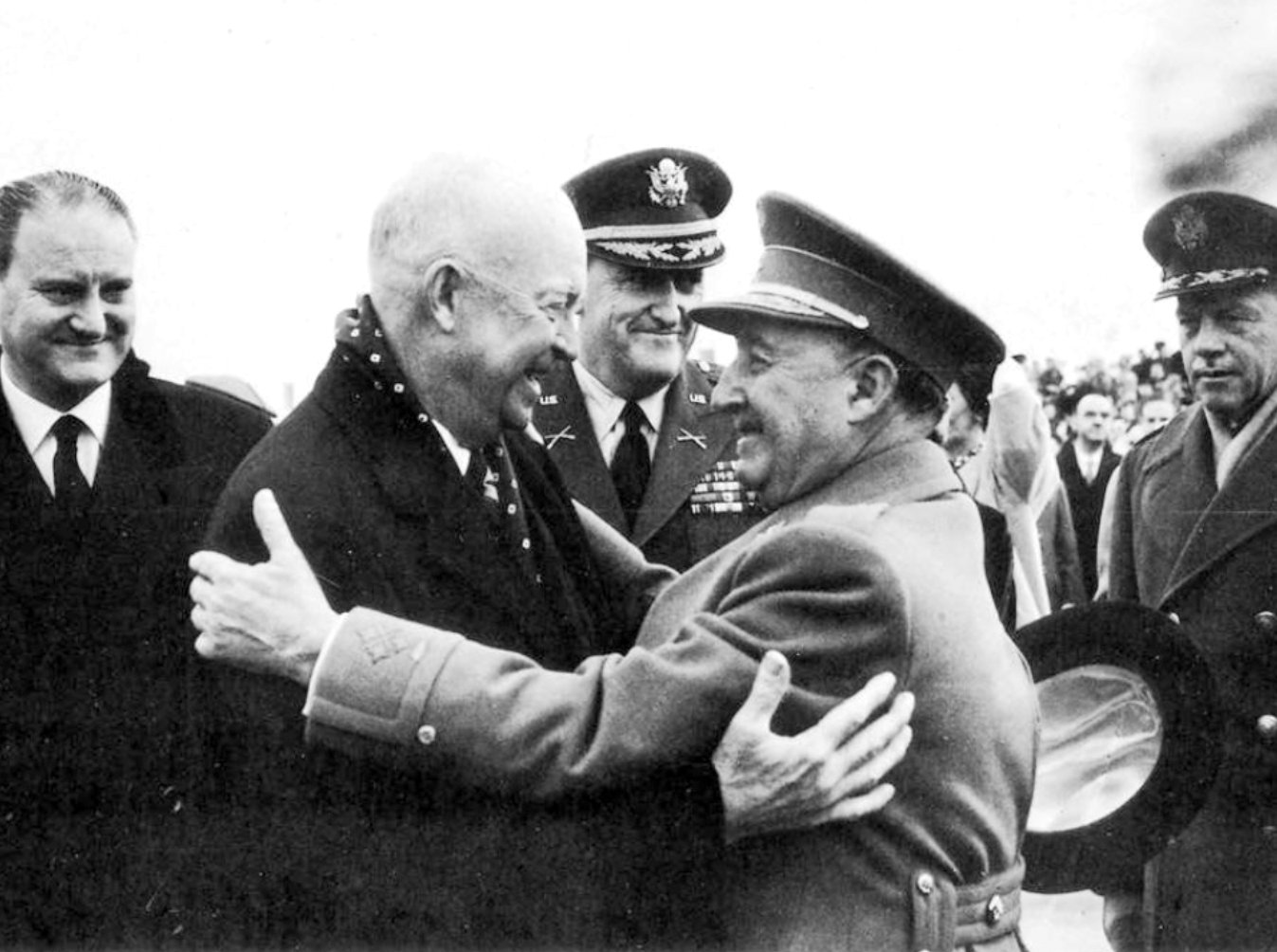
- File:Ike.png Eisenhowerismo - I deeply appreciate that you thawed relations with me and your support for Spain against the godless Communist hordes Vamos tío, come here and give me a hug!!!.
- File:Fash.png Fascismo - Thanks for the crucial assistance during the civil war! Not sure about this File:Gentile.png Actualism stuff, though.
- File:BritFash.png Fascismo Británico - Mi amigo guiri which translated cara al sol. Gibraltar is Spanish and I will not stop claiming it.
- File:PPF.png Fascismo Francés - Thank you Pétain for delivering these Maquis to me.
- File:OAS.png OAS - I provided you with support against File:FLN.png Algerian separatists.
- File:Imp.png Imperialismo - I didn't really want to decolonize, international pressure from the File:UNHelm.png UN forced me. And I made sure to inform people about how colonisation really isn't that bad.
- File:Heart-Integralism.png Integralismo - The original model from which my most cherished ideals and policies were born.
- File:Caudillo.png Caudillismo - ¡Papá!
- File:Trad.png Tradicionalismo - ¡Me gusta!
- File:CountEn.png Contra-Ilustración - I pride myself on having destroyed the wicked Enlightenment legacy from Spain.
- File:Rexism.png Rexismo - Okay Degrelle, you can stay in Spain, I can't let them execute you.
- File:Ilminism.png Ilminismo - I could never cooperate with File:Juche.png that mad communist, so I will only recognize and have relations with South Korea.
- File:Pinochet-hat.png Pinochetismo - My favorite dictator from South America, I respect your creative use of helicópteros.
- File:Castro.png Castrismo - Mi amigo from Cuba, the only comunista I like.
- File:SpaVox.png Voxismo - You defend many of my ideals and thank you for opposing the relocation of Franco's grave from the Valley of the Fallen. Continue to protect the unity of Spain!
- File:JuanPeron.png Peronismo - Based.
- File:Muslim 2.png Teocracia Islámica - Many Moroccans have joined for religious reasons in my crusade against the godless republicans and the Moors constitute a historical minority of Spain that I have tolerated all the time, also I love the traditional File:PanArab.png Arab-Spanish friendship and we work together against Israel. Also, if the commies have made a racist song against you saying "We fight against the Moors", you must be based, may your lord Allah be with you.
- File:Cball-Palestine.png Nacionalismo Palestino - I supported the Arabs against the Israeli invaders.
- File:Strato.png Estratocracia - Thank you for trying to restore me in 1981. ¡A mí la Legión!
Dudoso (Dubious)
[edit]- File:Nasser2.png Nasserismo - Most anti-Western Falangists admire you but I cannot get too close to your regime because with your pro-Soviet overtures you would compromise my relations with the USA.
- File:Hochi.png Pensamiento Ho Chi Minh - "We must give him credit for being a patriot who cannot be indifferent to the annihilation of his country [...] he could, without doubt, be the man of the hour needed by Vietnam." (Franco's letter to the American president). I still helped the US and South Vietnamese war effort, though.
- File:Mao.png Maoísmo - He adopted my guerilla strategies from the rift war and the civil war. I also recognized his government in 1973.
 Guevarismo - I only allowed you to enter Spain to meet your friend Peron during his exile.
- File:SpaPP.png Popularismo - Many of my adherents emigrated to the PP after the democratic transition, but you still remain too moderate and why do you accept local autonomies?
- File:Carlism.png Carlismo - Thank you for your help in the civil war but you aren't fit to rule Spain. The King I chose wasn't any of your claimants.
- File:Carlism.png File:LBubble.pngAnd now the Spaniards are suffering because of that.
Also you stole the civil war from me, I was originally going to be the one rising up.File:RBubble.png
- File:Carlism.png File:LBubble.pngAnd now the Spaniards are suffering because of that.

- File:Flang.png Falangismo - Jose Antonio is more useful as a martyr than as a political opponent.........
- File:Hayek.png Hayekismo y File:Orlib.png Ordoliberalismo - Gracias for the advice.
- File:Distributist.png Distributismo - I'll let you set up shop in Spain
if you shut down your dissident newspaper. - File:Nazi.png Nazismo - Thanks for the volunteers back in the civil war! Have some Blue Division! Also, don't worry, your men will be protected after your demise.
Don't bother asking for more, I'm not gonna send you anything else nor will I formally join your barbarous "World War" and I will allow some Jews refuge in my land. - File:Altl.png Alt-Lite - He should go offline, but at least he opposes the Reds.
- File:Reactlib.png Liberalismo Reaccionario - He really likes my post-war economic liberalization. Still, too democratic.
- File:Totalitarian.png Totalitarismo - A totalitarian state will harmonize in Spain the operation of all the capabilities and energy in the country, that inside the National Unity, the work esteemed as the most unavoidable must be the only exponent of the people's will. But I later abandoned you for a more respectable variant of authoritarianism after I halted the blessed White Terror and started to institute economic liberalization and gradual political thaw.
Even though America kinda pressured to implement these policies in exchange for aid and acceptance. - File:Demsocstar.png Socialismo Democrático - File:Cball-2Spainrepub.png Pro-Republican socialista libtard, but File:Allende.png Allendism isn't that bad and even I kinda like him.
- File:Ottoman.png Neo-Otomanismo - Some say he is my modern counterpart from Turquía.
- File:Persondignity.png Teoría de la dignidad de la persona - How are you supposed to be inspired by me? At least I treated my colonies better than you treated buddhists.
- File:PUNT-Nguema.png Nguemaísmo - In the end I also had to give up Equatorial Guinea, but you weren't the worst post-colonial leader and you maintained good relations with Spain.
- File:3princ.png Tridemismo - I really would have liked Chiang Kai-shek nationalists to defeat the communists like I did in Spain but they were too incompetent to have won ,also you overthrew your king.
I have to admit that File:Mao.png Mao won so in 1973 like much of the world I suspended formal relations with Taiwan and only recognized the PRC. - File:SpaNatSynd.png Nacionalsindicalismo - Good amigo during first Francoism but in the end the technocrats of File:OpusDei.png Opus Dei advised me to abandon the more syndicalist and corporatist policies in favor of free market which led to the Spanish miracle.
- File:Necon.png Neoconservadurismo - I won't join your godless crusade, but I'll give a little bit of aid in some areas I deem fit.
- File:Autarky.png Autarquía - I implemented you until 1959, but you didn't work so well, isolation made my economy stagnate. Why did the falangist old guard continue to support you anyway?
- File:Whitesup.png Nacionalismo Blanco - Some of my modern followers are you, but actually I didn't hold strong racial views, you sometimes completely ignore the fact that I allowed moors to fight in the Bando Nacional and tolerated their culture and religion at some point.
Subversivos (Subversives)
[edit]- File:Cball-2Spainrepub.png Republicanismo Español - "The Spanish Republic did not find itself free of obligations. For the most part the leaders were Freemasons. Before their duty to their country came their obligations to the Grand Orient. In my opinion, Freemasonry, with all its international influence, is the organization principally responsible for the political ruin of Spain, as well as the murder of Calvo Sotelo, who was executed in accordance with orders from the Grand Secretary of Freemasonry in Geneva."
- File:KKKf.png Klansmanismo - Tf, why do the members of the Lincoln brigade say that I am him? I am literally an ultra-Catholic who persecuted Protestants like him in the early years of the regime.
- File:Antifa.png Maquis - Did you really believe that your miserable invasion of the Val d'Aran could overthrow my regime? We kicked you like in 1939.
- File:Euskadi Carlism.png Carlismo de Euskadi - Carlos Hugo is just a socialist and pseudo-Carlist, we worked with the real Carlists to punish your betrayal.
- File:Fed.png Federalismo - These autonomous communities that divide the nation have been one of the biggest mistakes of the democratic transition, centralization is the only way.
 Jacobinismo - A File:Satan.png demonio who speaks French, his revolutionary ideas must never touch our sacred ground.
- File:Neoliberal-icon.png Neoliberalismo - I knew this would happen to my beloved homeland. That goddamn File:Necon.png neocon tricked me!
- File:Zio.png Sionismo - I sheltered some of your people during the Holocaust, but you'd later betray me and voted against my admission to the UN. You hypocritical fool! I diplomatically supported the Arab countries against you and didn't recognize your illegal settlements as revenge.
- File:Ajazz.png Jazz - Jazz is bad, you will be limited.
- File:Conmon.png Monarquismo Constitucional - Scheming traitorous scum!
- File:Mediastocracy flair.png Mediacracia - If I don't like what you're writing, you're done.
- File:PCE.png Marxismo–Leninismo - ¡Al paredón!
- File:Prog-u.png Progresismo - You're nothing more than a puppet of terrorists and a costumed Marxist!
 Anarcosindicalismo y File:Libsoc.png Socialismo Libertario - ¡HEMOS PASADO! Seethe! Cope! Dilate!
- File:AnInde.png Anarquismo Independentista - JA JA JA JA, can you cry louder?
- File:Freemason .png Masonería - "We do not rule out that it will change in the future, but for now it is. I am convinced that Masonry is very good for England in England; the bad thing is that in Spain it is still very good for England."
- File:ProtTheo.png Teocracia Protestante - I HAVE PERSECUTED YOU, COPE!
Why did the pope pressure me to pass the Law of Religious Freedom in 1967? - File:ETA.png Nacionalismo de Izquierda - YOU VASCOS TERRORISTAS KILLED MY PRIME MINISTER BLANCO! IF IT WASN'T FOR YOU VASCOS TERRORISTAS SPAIN WOULD STILL BE UNDER MY REGIME!!!
- File:Honk.png Sábado noche en Vivo - I. AM. NOT. DEAD. I am clearly alive and breathing!
- File:Tito.png Titoísmo - So many Yugoslav partisan commanders were in the international brigades... May you perish, Tito.
- File:Kemal.png Kemalismo - I’ll never forgive you for supporting File:Cball-2Spainrepub.png him. You also disgust me by being progressive, secular, leftist, and anti-fascist.
- File:Dem.png Democracia - We do not believe in government through the voting booth. The Spanish national will was never freely expressed through the ballot box. Spain has no foolish dreams.
- File:Cardenas.png Cardenismo - Why did you shelter dissidents?


Gallery
[edit]Portraits
[edit]-
Old portrait
Comics and Artwork
[edit]Further Information
[edit]Literature
[edit]Wikipedia
[edit]- Francoist Spain
- Sociological Francoism
- First Francoism
- Spanish miracle
- National Catholicism
- Stabilization Plan
- Fundamental Laws of the Realm
- Spanish Syndical Organization
Youtube
[edit]Videos
[edit]- Ten Minute History - The Spanish Civil War and Francisco Franco (Short Documentary)
- El Primer Franquismo- A Toda Leche
- El Final Del Franquismo- A Toda Leche
- Franco and Fidel: A Strange Friendship
Citations
[edit]- ↑ Blaverismo is an anti-Catalan and conservative movement that developed in Valencia during the democratic transition which is characterized by the assertion of a separate Valencian identity in opposition to pan-Catalanism and Catalan nationalism. Some founders were former Francoists and some factions have reactionary or fascist tendencies, for these reasons, it is still considered a far-right movement by detractors.
- ↑ https://es.m.wikipedia.org/wiki/Democracia_org%C3%A1nica
- ↑ Openly praised Franco for executing ETA separatists.
- ↑ "As for me, I am against freedom. I am for the blessed Inquisition. Freedom is sh*t, and that's why all these countries founder, from an excess of liberty."
- ↑ https://www.goal.com/en/news/general-franco-real-madrid-king-history-behind-clubs-link-spain-establishment/fcoqldp8h2bb1841o2rspmuhe


.svg)